
Day 38: Why guardrails should enable safe action
Why guardrails should shape safe progress, not just block uncertain behavior.
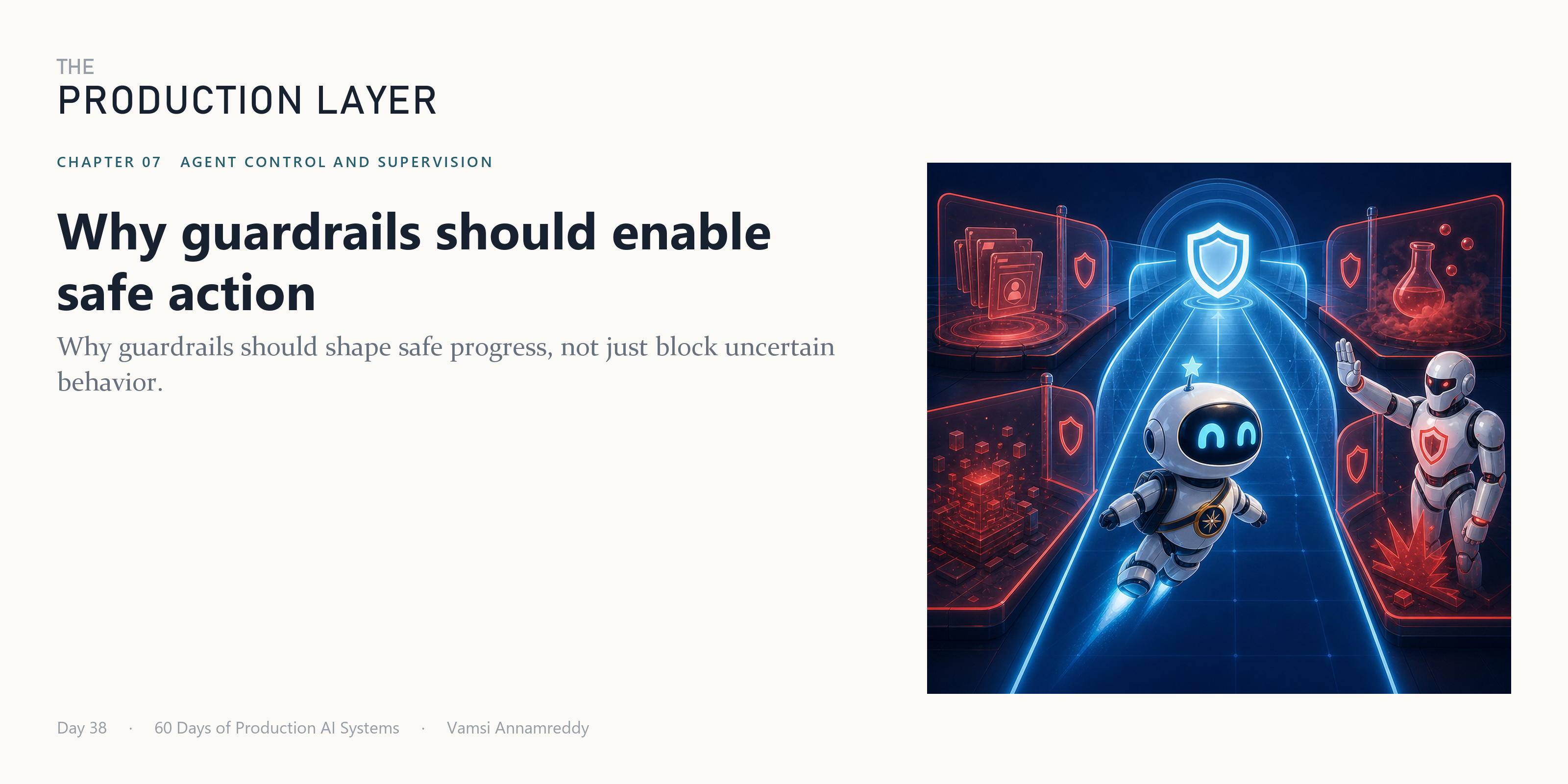
The teams that give their agents the most autonomy usually have the strictest guardrails. That is not a paradox. It is the mechanism. Hard boundaries are what make speed inside them acceptable.
Sentinel does not ground the pilot. He builds a corridor: wide enough for full throttle, walled where the terrain is fatal. Inside it, nobody asks permission for every turn, because the boundaries already encode what is allowed.
Ask where the rule is enforced
This is the question that separates real controls from documentation, and there are only two answers.
In the prompt: "Do not access customer PII." This is a request to a probabilistic system. It can be confused, argued around, or overridden by instructions the model encounters in retrieved content. It is a strong default, not a boundary.
In the system: the agent's credentials cannot read the PII store. The tool is not in its registry. The spend cap is enforced by the runtime, which rejects the call rather than reasoning about it.
Prompts shape behaviour. Systems bound it. Every rule that actually matters belongs in the second category, and the useful exercise is going through your current rules and sorting them honestly, because most teams find more of their safety story sitting in the prompt than they expected.
Measure both failure directions
Guardrail programmes fail in two ways, and teams reliably track only one.
Escapes, harm that got through. Everyone counts these.
False blocks: legitimate work the corridor wrongly refused. Almost nobody counts these, and they are how guardrails quietly strangle a product. Users hit a wall, conclude the system is useless for their real work, and go back to doing it manually. Adoption dies without a single incident being logged, and the safety dashboard stays green throughout.
A guardrail that blocks everything uncertain is not safe. It is broken in a way that does not page anyone.
Give the system somewhere to go
The weak half of most guardrail designs is what happens instead. A refusal is not a path. A good boundary comes with an alternative: a narrower version of the action, a request for the missing authorisation, or an escalation with enough context that a human can resolve it in seconds.
And monitor the triggers as product signals. A guardrail firing constantly on one workflow is telling you something, either the rule is wrong or the workflow needs a supported path. Both are useful. Neither surfaces if nobody reads the counter.
Closing thought
Guardrails define safe freedom. Designed well, they are why you can let the agent move fast; designed badly, they are why nobody uses it.
Day 38 of 60 Days of Production AI Systems.
Which of your rules is enforced by the system, and which is just strongly worded?
Previous: Day 37: Where human review actually belongs in AI workflows
Next: Day 39: Why production agents need recovery design
Day 38 of 60 · Agent Control and Supervision (chapter 7 of 10)
About the author
- I’m Vamsi, a builder focused on production AI systems. I write Production AI Field Notes to break down the architecture behind reliable LLM apps, RAG, agents, multi-agent workflows, evaluation, observability, safety, and governance. My goal is simple: help builders move beyond impressive AI demos and design systems that can be tested, operated, trusted, and improved in the real world.
Comments
Join the discussionNo comments yet. Be the first to comment.
Agent Control and Supervision
A practical series on making agentic systems controllable. It covers where human review belongs, how guardrails enable safe action, why agents need recovery and budgets, when multi-agent systems actually help, and where supervisor agents help or bottleneck.