
Day 41: Why one giant agent is rarely the cleanest design
Why multi-agent systems should reduce complexity through specialization, not add agents for novelty.
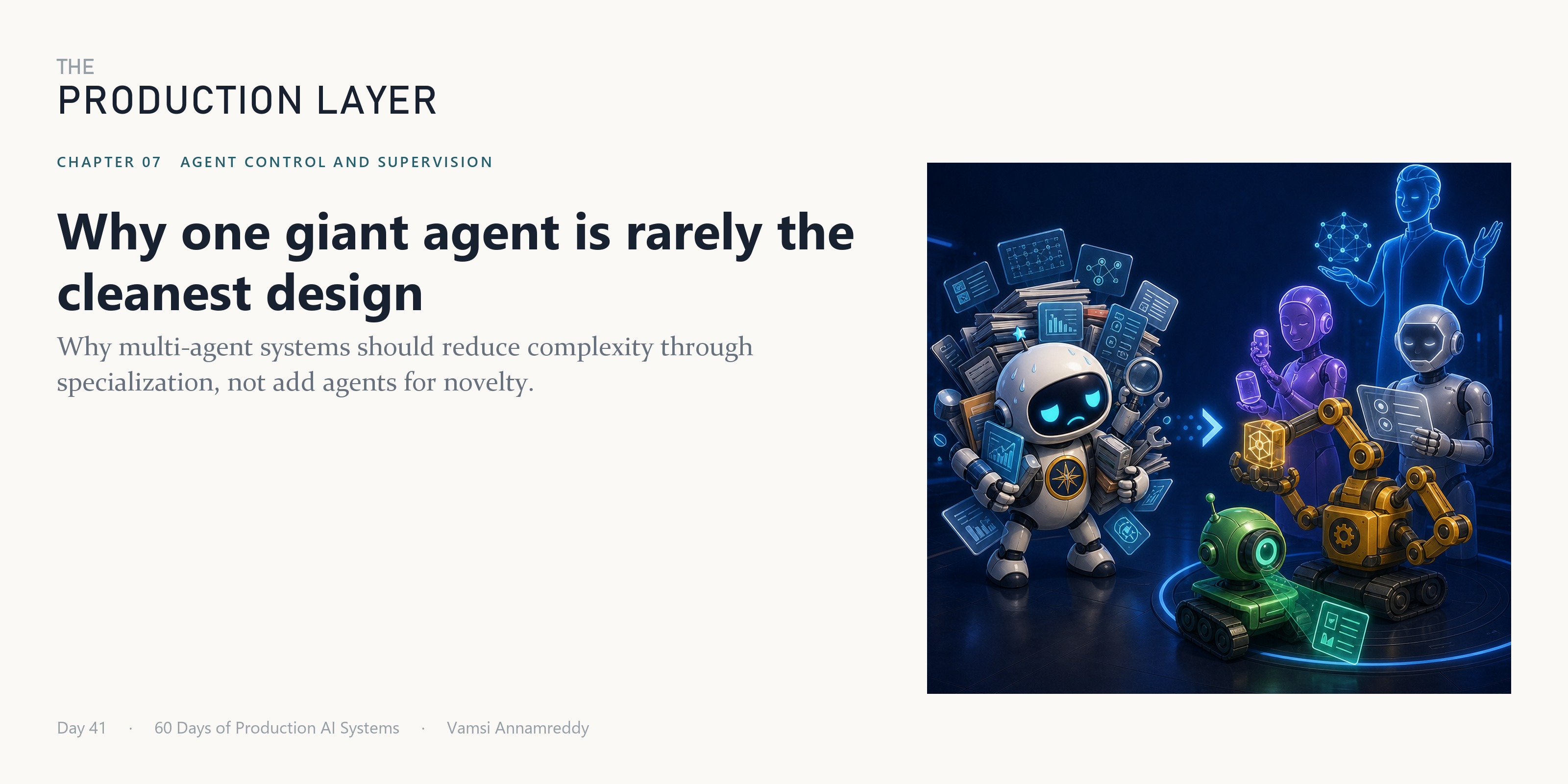
Before building a multi-agent system, the quiet part: plenty of teams that needed one agent built six.
Multi-agent architecture has three honest justifications. Everything else is enthusiasm with a diagram.
The three reasons
Separation of permissions. The agent that reads everything should not be the agent that can write anything. That split is a security property no prompt can provide, and it alone justifies a second agent.
Genuine parallelism. Thirty documents to analyse independently is thirty agents' worth of simultaneous work. Sequential work gains nothing from a crowd. It just adds handoffs between steps that were already in order.
Context isolation. An agent with one job and only that job's context reliably outperforms one juggling five roles whose instructions interfere. "Be exhaustive" and "be concise" in the same system prompt produce an agent that is inconsistently both.
If none of the three applies, the single agent wins.
The coordination tax
Every additional agent levies one, and it is paid on every request, forever: handoffs that drop context, shared state that drifts, conflicts needing arbitration, and an entire category of failure that exists only between agents and therefore appears in none of your per-agent metrics.
That last point is the expensive one. When each component tests clean and the system still fails, the fault is almost always in the seams, and seams are what you bought when you split.
The test
Not "would specialists be elegant?" but: which of the three reasons applies here, specifically?
Write the answer down. If it takes more than a sentence, or if the sentence contains the word "cleaner," it is probably enthusiasm. One good agent with well-scoped tools beats a committee for most workloads, and it is dramatically easier to debug at 2am.
Start with one. Split when a boundary becomes real, when you genuinely cannot give one agent both sets of permissions, or when you are demonstrably waiting on work that could run in parallel.
Closing thought
Specialisation can beat one giant agent. It can also just be one giant agent with extra network calls and a nicer architecture diagram.
The complexity is a loan. Make sure you know what you borrowed it for.
Day 41 of 60 Days of Production AI Systems.
Which responsibility in your current agent is genuinely a different specialist job?
Previous: Day 40: Why autonomy needs budgets
Next: Day 42: Why supervisor agents help and where they bottleneck
Day 41 of 60 · Agent Control and Supervision (chapter 7 of 10)
About the author
- I’m Vamsi, a builder focused on production AI systems. I write Production AI Field Notes to break down the architecture behind reliable LLM apps, RAG, agents, multi-agent workflows, evaluation, observability, safety, and governance. My goal is simple: help builders move beyond impressive AI demos and design systems that can be tested, operated, trusted, and improved in the real world.
Comments
Join the discussionNo comments yet. Be the first to comment.
Agent Control and Supervision
A practical series on making agentic systems controllable. It covers where human review belongs, how guardrails enable safe action, why agents need recovery and budgets, when multi-agent systems actually help, and where supervisor agents help or bottleneck.