
Day 55: Why observability is not optional for AI systems
Why production AI needs traces across prompts, context, retrieval, tools, costs, and decisions.
Every agent team eventually hits the same moment. A user reports a bad outcome from yesterday, and someone asks: can we see what it did?
The answer to that question was decided months earlier, when tracing either was or was not built.
Logging the answer is not tracing
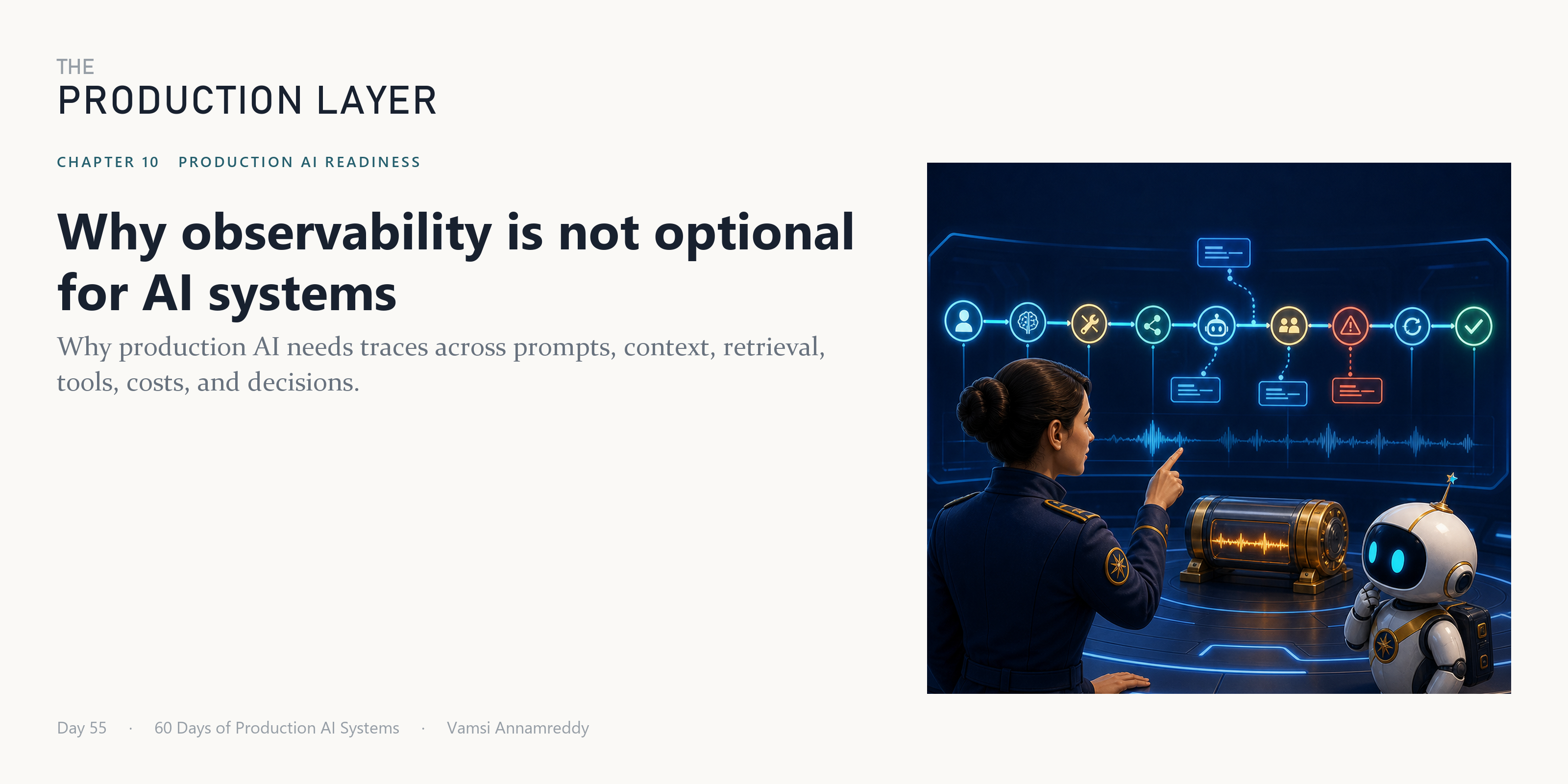
A production trace connects the full causal chain for one request, under one ID, navigable end to end.
| Step | What to capture | What it lets you answer |
|---|---|---|
| Input | request, user context, request ID | Can we reproduce it? |
| Retrieval | queries, filters, source IDs, ranks | Was the evidence there, and did it rank? |
| Model call | prompt, response, tokens, model version | What did it actually see? |
| Tool call | tool, arguments, result, duration | What did it do to the world? |
| Handoff | payload passed between agents | Where did context get lost? |
| Decision | output, confidence, owner | Who is accountable? |
What it converts
Adjectives into locations. "The model hallucinated" becomes "the 2024 policy entered context at step 3 because the freshness filter was not applied." Different sentence, different owner, different fix.
Guesses into attribution. The step burning 80% of your tokens becomes visible, and it is rarely the one people predicted.
Apologies into answers. When compliance asks why the system approved something, you replay it rather than reconstructing it from memory and hope.
Capture context without capturing everything
The tension nobody mentions: traces are useful in proportion to their detail, and prompts and retrieved documents routinely contain personal data.
Resolve it deliberately, redact or tokenise sensitive fields, store references rather than payloads where you can, and set retention that satisfies both debugging and privacy. This is a design decision, and making it late usually means making it badly, in one direction or the other.
The retrofit trap
Teams add tracing after the incident that needed it. Which means debugging that incident blind, and instrumenting a system that is now large, live, and load-bearing.
Instrument on day one, while it is small enough that instrumenting is easy.
Closing thought
You cannot operate what you cannot see, and AI failures are particularly good at looking like normal answers. Observability is the control surface for production AI, not a nice-to-have you add once things get serious. Things being serious is when you need it to already exist.
Day 55 of 60 Days of Production AI Systems.
Previous: Day 54: Why multi-agent systems need decision rules
Next: Day 56: Why evaluating the model is not enough
Day 55 of 60 · Production AI Readiness (chapter 10 of 10)
About the author
- I’m Vamsi, a builder focused on production AI systems. I write Production AI Field Notes to break down the architecture behind reliable LLM apps, RAG, agents, multi-agent workflows, evaluation, observability, safety, and governance. My goal is simple: help builders move beyond impressive AI demos and design systems that can be tested, operated, trusted, and improved in the real world.
Comments
Join the discussionNo comments yet. Be the first to comment.
Production AI Readiness
A closing series for moving from AI demos to systems people can trust. It covers observability, workflow evaluation, prompt injection and data leakage risk, governance, end-to-end production architecture, and the complete AI ecosystem map.