
Day 58: Why governance belongs in the architecture
Why governance belongs in the architecture, not in a document after launch.
Run this test on any AI system you have in production: ask who owns it. A name, not a team, a person who answers when it misbehaves.
If the room goes quiet, that system has an architecture gap. It just does not appear on any diagram.
Governance decomposes into engineering artifacts
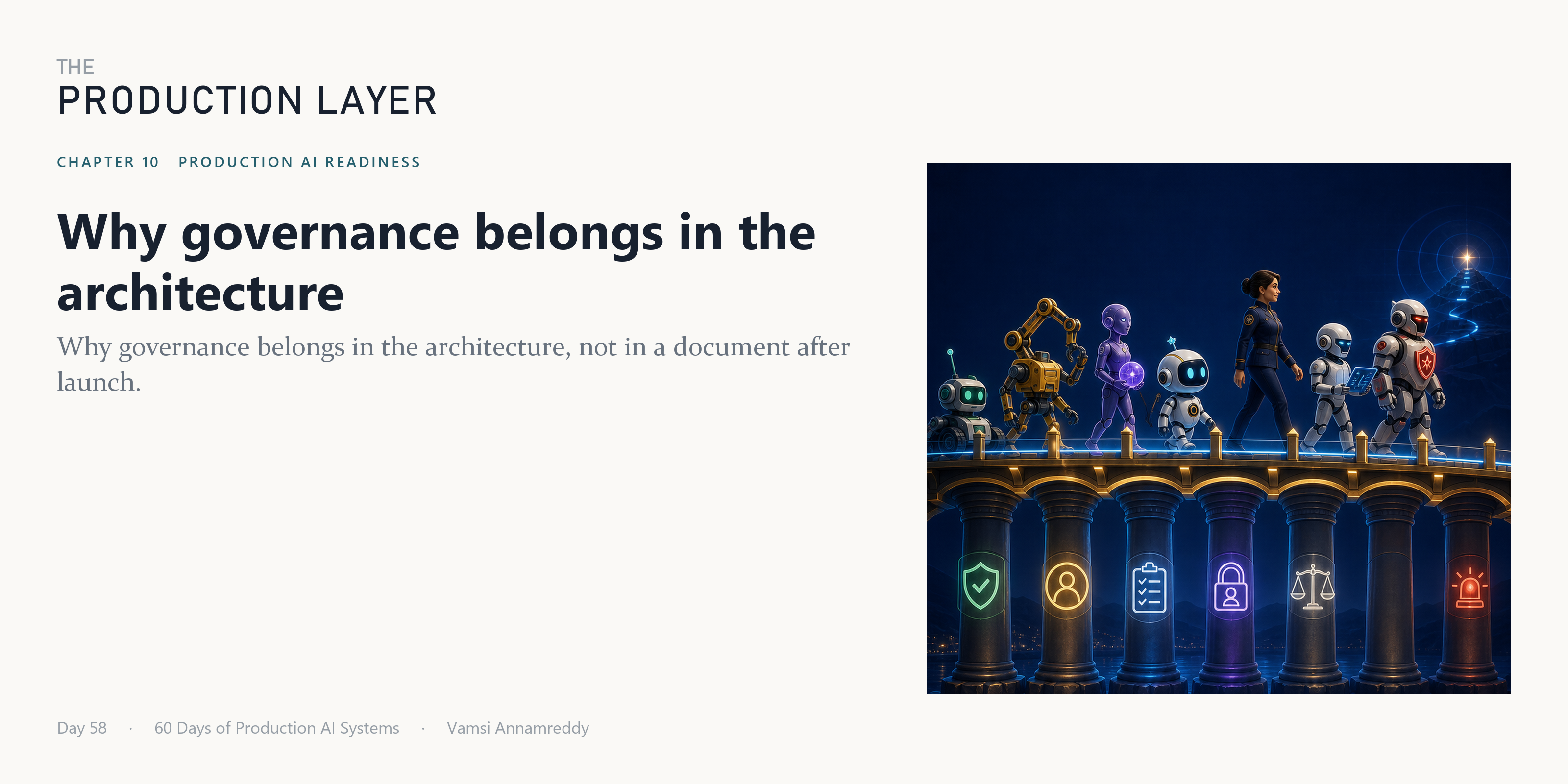
The word sounds like paperwork. In practice it is six concrete things, each with a specific failure when missing:
- Policy: what the system may and may not do, written before the incident that would have needed it. Missing: every edge case becomes an argument under time pressure.
- Approval, who signed off on deployment, on the record. Missing: "who decided this was ready?" has no answer.
- Audit — decisions reconstructable months later. This is a data-retention design choice, made up front or not at all.
- Privacy, whose data flows through, on what basis, and how it exits when someone requests deletion.
- Fairness: behaviour tested across the people actually affected, not just the average case.
- Incident response, who gets paged, what gets switched off, how fast.
None of these are documents. They are architecture with names attached, and the pattern in teams that ship AI durably is that they design them in from the start, when each is a small decision rather than a retrofit.
Retrofitted accountability leaks
Adding audit trails to a system that was not built to produce them means reconstructing history you never stored. Adding a deletion path means finding data you never tracked. Adding approval gates means re-architecting flows already in production.
Each of these costs roughly an order of magnitude more after launch than before, and the retrofitted version is usually partial in ways nobody notices until it is tested by an actual request.
Connect policy to controls
The failure mode worth naming: a policy document that no technical control enforces.
"The system must not access customer PII without consent" is a sentence. What enforces it? If the answer is "the prompt asks it not to," you have documentation rather than governance, and the two are only distinguishable during an audit or an incident, which is precisely when the difference is expensive.
Governance is part of the architecture. It is how the system earns permission to operate, and autonomy that scales without ownership scaling alongside it is not progress. It is deferred liability.
Day 58 of 60 Days of Production AI Systems.
Previous: Day 57: Why retrieved content must stay untrusted
Next: Day 59: Why production AI is coordinated infrastructure
Day 58 of 60 · Production AI Readiness (chapter 10 of 10)
About the author
- I’m Vamsi, a builder focused on production AI systems. I write Production AI Field Notes to break down the architecture behind reliable LLM apps, RAG, agents, multi-agent workflows, evaluation, observability, safety, and governance. My goal is simple: help builders move beyond impressive AI demos and design systems that can be tested, operated, trusted, and improved in the real world.
Comments
Join the discussionNo comments yet. Be the first to comment.
Production AI Readiness
A closing series for moving from AI demos to systems people can trust. It covers observability, workflow evaluation, prompt injection and data leakage risk, governance, end-to-end production architecture, and the complete AI ecosystem map.