
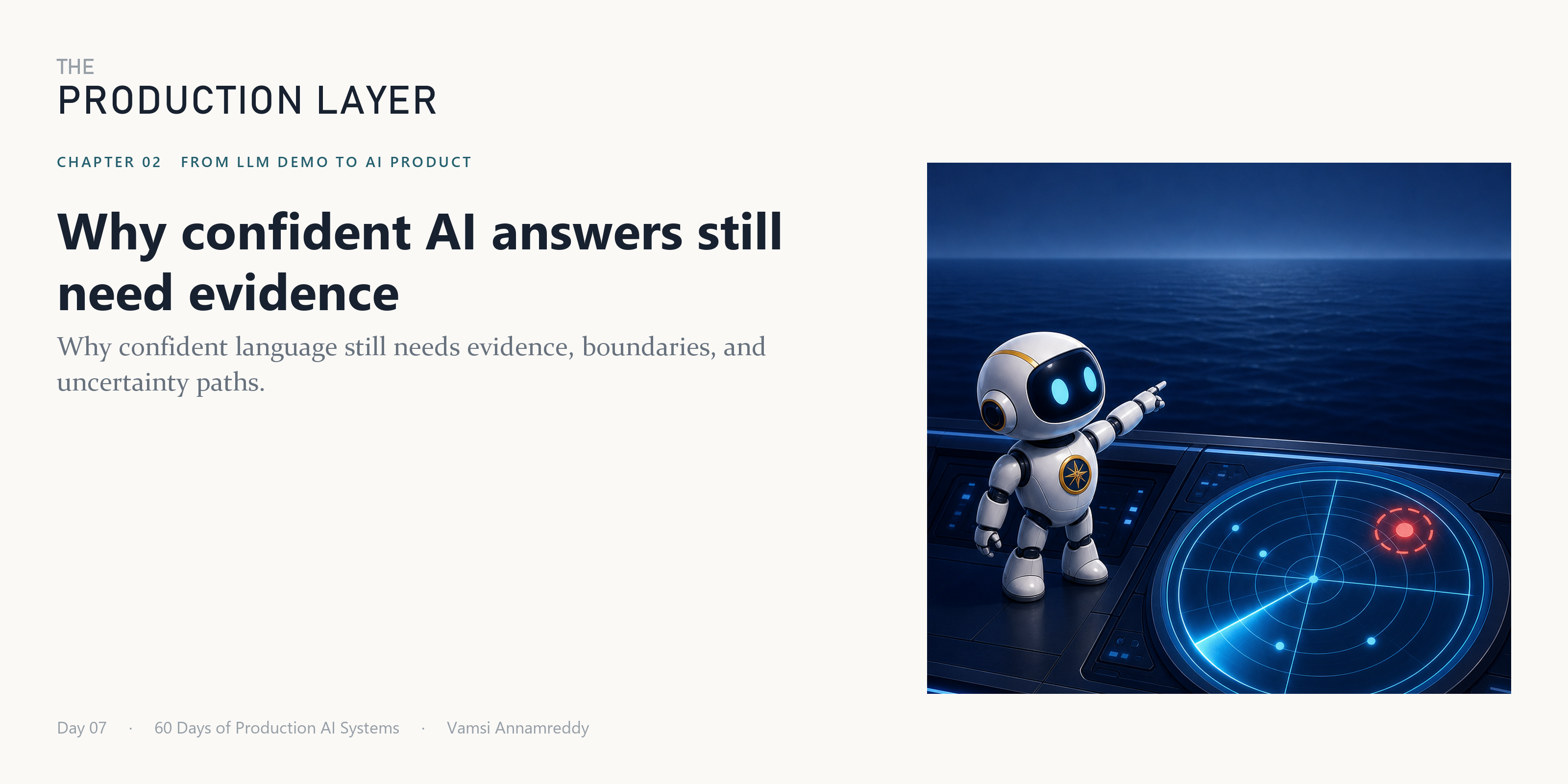
Day 07: Why confident AI answers still need evidence
Why confident language still needs evidence, boundaries, and uncertainty paths.
The dangerous hallucinations are not the strange ones. Those get caught.
The dangerous ones are fluent, confident, and almost right, a real policy with one wrong number, a real process with one invented step, a correct answer to a question nobody asked.
Confidence is not evidence.
A fluent answer still has to earn trust through sources, boundaries, uncertainty handling, and a path for review.
Why it does not look like a bug
Every other failure in software announces itself. Exceptions, timeouts, 500s, red tests.
A confident wrong answer renders perfectly. It has the same tone, structure, and apparent authority as a correct one, because fluency and accuracy are produced by the same mechanism and only one of them is being optimised for at generation time.
So it does not get reported as a failure. It gets absorbed — by a user who acts on it, or by one who quietly notices, stops trusting the feature, and goes back to doing it manually. Trust leaks out well before anyone opens a ticket.
Stop treating it as a model defect
There is a comfortable framing where hallucination is a temporary model limitation that will be solved by the next release. It will not be, entirely, and waiting is not a strategy.
The productive framing: hallucination is a system-design problem about evidence and trust. Three decisions follow from it, and none require a better model:
- Which claims must carry evidence before a user sees them. Not all. That is unworkable. But the material ones: numbers, eligibility, policy, anything a person might act on.
- What the system says when it does not know. This has to be an explicit, designed path. The default behaviour of a language model handed an unanswerable question is to answer it anyway.
- Who owns accuracy in production, and what they monitor.
Pressure-test with the unanswerable
Take a question your sources genuinely cannot answer and watch what happens.
Refuses? Your evidence rules are real. Hedges honestly? Good. Produces a confident, plausible, entirely invented answer? You have just seen exactly what your users will encounter, and unlike them, you know it is wrong.
That fifteen-minute test tells you more about your system's trustworthiness than any benchmark score.
Confident AI answers still need evidence. The model's job is to generate; the system's job is to decide what generation is allowed to reach a person unverified.
Day 7 of 60 Days of Production AI Systems.
Which claims in your output should require a source before a user ever sees them?
Previous: Day 06: Why creativity settings are product decisions
Next: Day 08: Why production AI needs structured outputs
Day 7 of 60 · From LLM Demo to AI Product (chapter 2 of 10)
About the author
- I’m Vamsi, a builder focused on production AI systems. I write Production AI Field Notes to break down the architecture behind reliable LLM apps, RAG, agents, multi-agent workflows, evaluation, observability, safety, and governance. My goal is simple: help builders move beyond impressive AI demos and design systems that can be tested, operated, trusted, and improved in the real world.
Comments
Join the discussionNo comments yet. Be the first to comment.
From LLM Demo to AI Product
A practical bridge from language-model demos to usable AI products. This series covers hallucination, structured outputs, product boundaries, chatbot versus workflow versus agent choices, and the first RAG and ingestion decisions that make answers more trustworthy.