
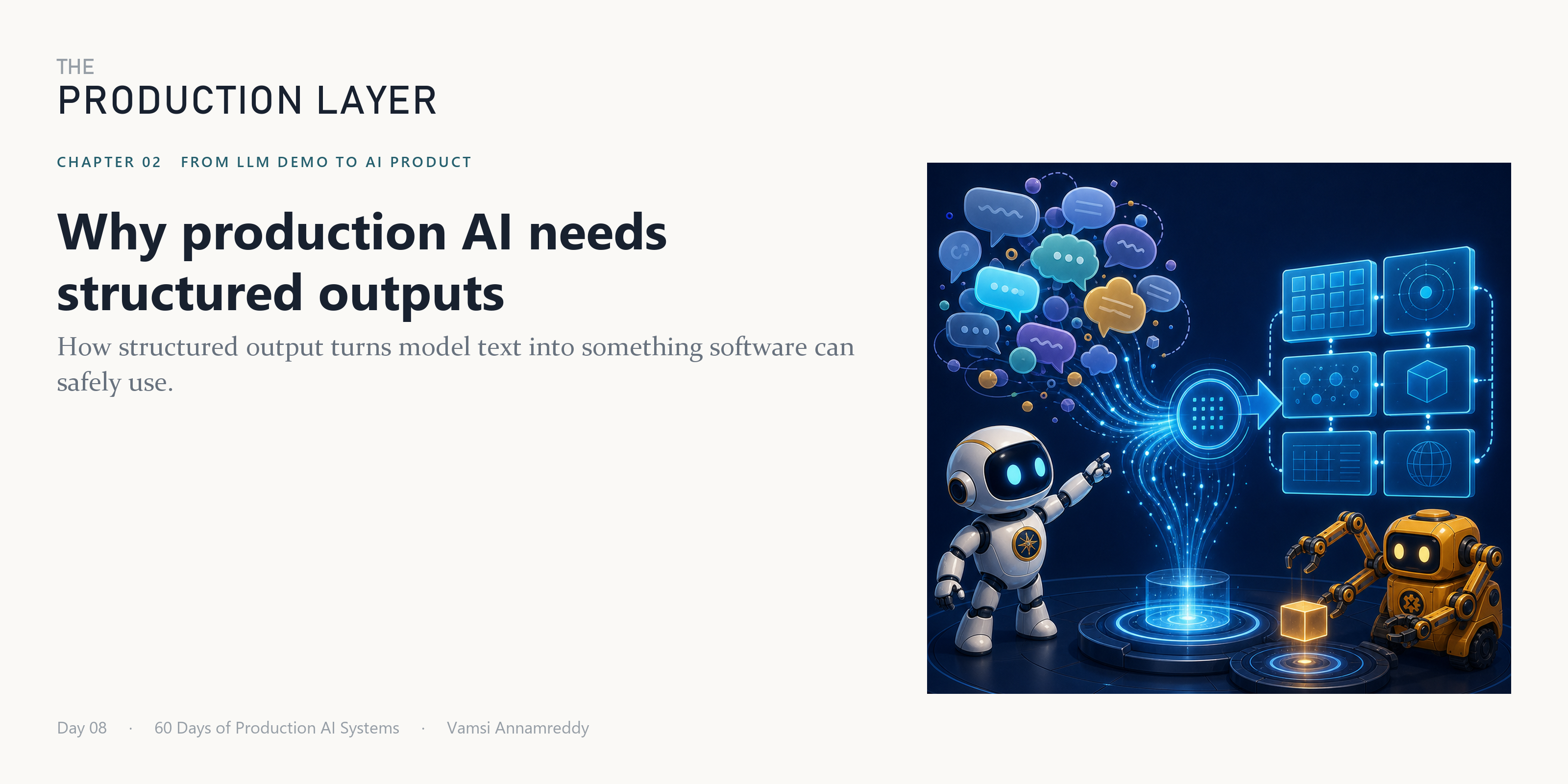
Day 08: Why production AI needs structured outputs
How structured output turns model text into something software can safely use.
A beautifully written paragraph is a terrible API response.
Humans read prose. Software needs fields — something it can validate, route, store, and act on without guessing. The moment a model's output feeds another system rather than a person, free-form text stops being a feature and becomes a parsing problem you will maintain forever.
What a real output contract looks like
{
  "answer": "The customer is eligible for escalation.",
  "decision": "escalate",
  "confidence": 0.82,
  "evidence_ids": ["ticket-1842", "policy-returns-03"],
  "missing_information": [],
  "next_action": {
    "type": "create_case",
    "owner": "support_ops"
  }
}
The point is not JSON. The point is that every field is something the system can check before anything irreversible happens. decision is a closed set, so an unexpected value is caught rather than acted on. missing_information gives the model a legitimate way to signal incompleteness instead of inventing a value to fill the gap. evidence_ids makes the claim traceable.
That last one matters more than it looks: a schema field is a much stronger prompt for grounding than an instruction is.
Design the shape before the prompt
The instinct is to write the prompt, look at the output, and then work out how to parse it. That order produces a schema shaped by whatever the model happened to emit.
Reverse it. Ask what downstream code needs to receive in order to act safely, define that, and write the prompt to satisfy it. The schema is the requirement; the prompt is the implementation.
The fallback
Validation is only half a contract. The other half is what happens when validation fails, because it will, on some input, at some point.
Retry with the error attached? Fall back to a narrower model call? Route to a human? Fail the request cleanly? Pick one deliberately, because the default is worse than all of them: partially-valid output flowing into a system that assumed it was fine.
Test this on a genuinely awkward request, not a clean one. Empty inputs, contradictory inputs, requests that fall outside scope. Those are what produce malformed output in production.
Closing thought
Structured output is where AI starts behaving like a dependable software component instead of a text generator you hope stays consistent.
If the system expects structure, ask for structure, and then verify you got it.
Day 8 of 60 Days of Production AI Systems.
What downstream step would break first if your model returned prose instead of the contract you expected?
Previous: Day 07: Why confident AI answers still need evidence
Next: Day 09: Why a capable model is still not a product
Day 8 of 60 · From LLM Demo to AI Product (chapter 2 of 10)
About the author
- I’m Vamsi, a builder focused on production AI systems. I write Production AI Field Notes to break down the architecture behind reliable LLM apps, RAG, agents, multi-agent workflows, evaluation, observability, safety, and governance. My goal is simple: help builders move beyond impressive AI demos and design systems that can be tested, operated, trusted, and improved in the real world.
Comments
Join the discussionNo comments yet. Be the first to comment.
From LLM Demo to AI Product
A practical bridge from language-model demos to usable AI products. This series covers hallucination, structured outputs, product boundaries, chatbot versus workflow versus agent choices, and the first RAG and ingestion decisions that make answers more trustworthy.