
Day 09: Why a capable model is still not a product
Why strong model capability still needs workflow, product, and ownership design.
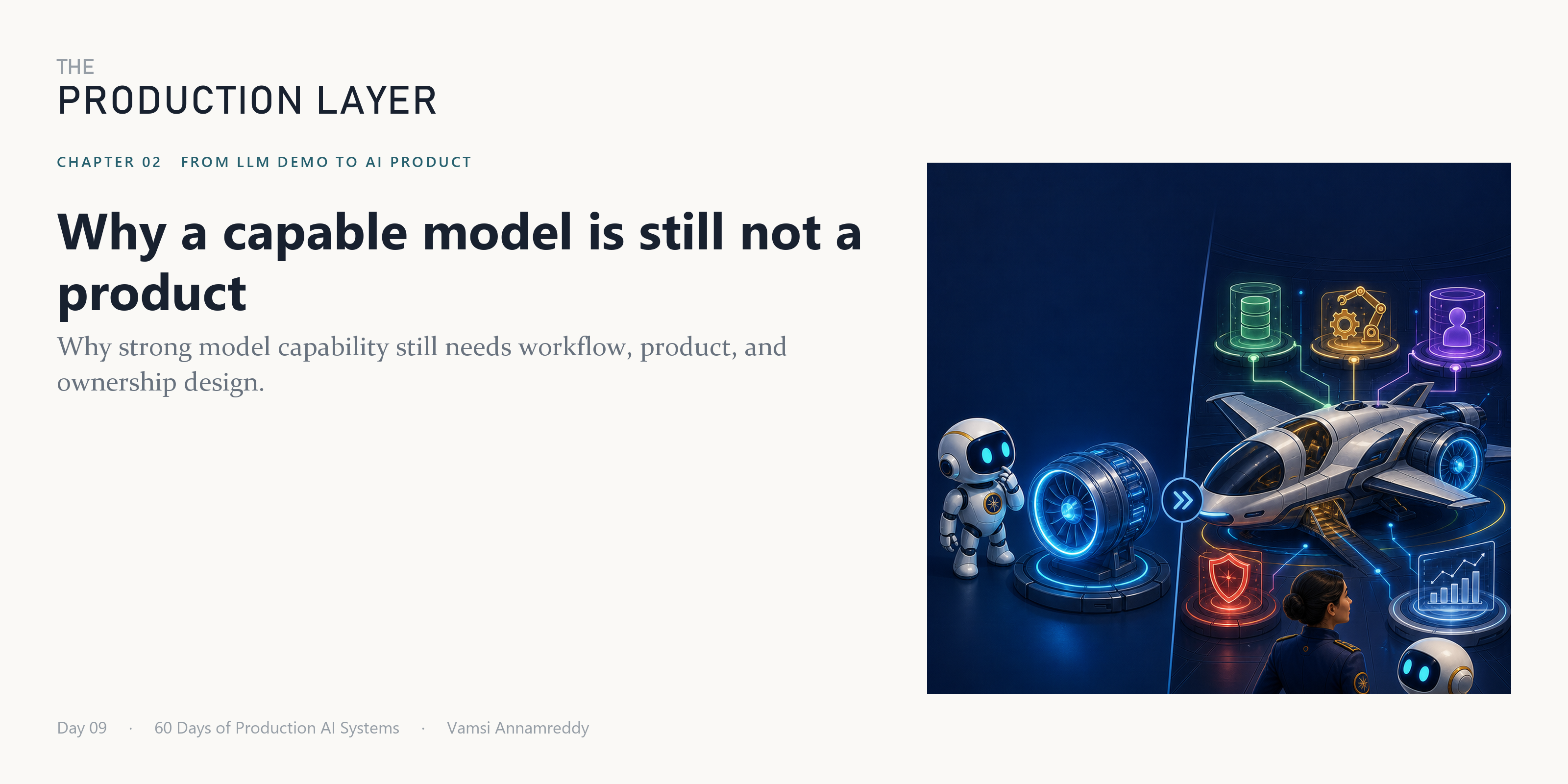
Users never experience your benchmark scores.
They experience the wait. The empty state before they know what to type. What happens when it fails. Whether they can tell if the answer is trustworthy. Whether the whole thing saved them any effort compared to doing it themselves.
A model can be excellent at all of that being terrible.
The happy path is the easy path
Here is the pattern I keep seeing. A team demos an AI feature: the input is well-formed, the answer is good, everyone agrees it is ready. It ships. Adoption is poor and nobody can explain why.
The reason is almost always off the happy path. These are the states nobody designed, because the demo never visited them:
- Loading. Eight seconds of nothing feels broken. Streaming the response changes the perceived experience more than a model upgrade would.
- The empty state. Users faced with a blank box do not know what the system can do, so they ask something trivial, get a trivial answer, and conclude it is trivial.
- Failure. What does the user see when it goes wrong, and can they do anything about it, or is it a dead end?
- Recovery. Wrong answer. Now what? Retry, refine, edit, escalate to a human? If the answer is "start over," most users just leave.
- Trust signals. Can they tell a well-grounded answer from a guess? Without that, they either over-trust it or abandon it, and both are failures.
Measure completion, not answer quality
This is the shift that reframes everything: track whether users finish the job, not whether the output looks impressive.
Answer quality is a component metric. Task completion is the product metric, and the two diverge constantly. A correct answer that took ninety seconds, or that the user could not verify, or that arrived with no way to act on it, did not complete anything.
Once you measure completion, the priorities usually reorder themselves, and the top of the list is rarely the model.
A test for readiness
Ask the team to describe the failure states before the happy path. What the user sees while waiting, when it breaks, when the answer is wrong, when they want to try again.
If those descriptions are vague, the feature is not ready, regardless of how the model scores.
Closing thought
Model capability creates possibility. Application design turns possibility into value, and it is where most AI products are actually won or lost.
Day 9 of 60 Days of Production AI Systems.
Previous: Day 08: Why production AI needs structured outputs
Next: Day 10: When to use a chatbot, workflow, or agent
Day 9 of 60 · From LLM Demo to AI Product (chapter 2 of 10)
About the author
- I’m Vamsi, a builder focused on production AI systems. I write Production AI Field Notes to break down the architecture behind reliable LLM apps, RAG, agents, multi-agent workflows, evaluation, observability, safety, and governance. My goal is simple: help builders move beyond impressive AI demos and design systems that can be tested, operated, trusted, and improved in the real world.
Comments
Join the discussionNo comments yet. Be the first to comment.
From LLM Demo to AI Product
A practical bridge from language-model demos to usable AI products. This series covers hallucination, structured outputs, product boundaries, chatbot versus workflow versus agent choices, and the first RAG and ingestion decisions that make answers more trustworthy.