
Day 31: Why agents need outcomes, boundaries, and stop conditions
Why agents need clear outcomes, boundaries, budgets, and stop conditions before autonomy.
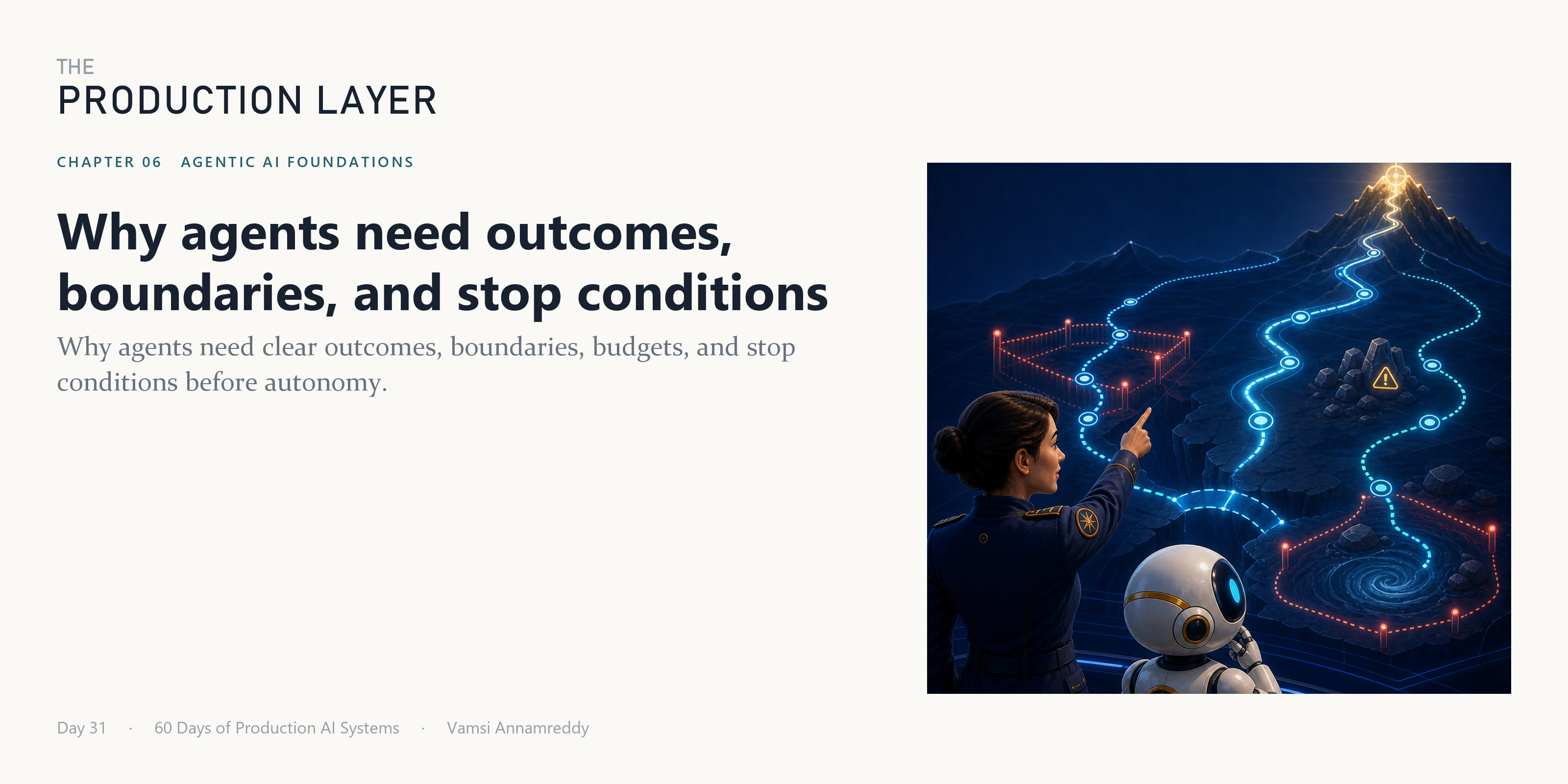
A workflow follows your steps. An agent pursues your goal. That difference sounds philosophical right up until you have to write the goal down.
Because the goal you hand an agent is a specification, and it gets executed with a compiler's literalism. Underspecify it and the agent does not fill the gaps with your intent. It fills them with whatever best satisfies the words you actually used.
Three things that have to be written down
Success criteria a machine can check. "Improve the report" is not a criterion; it is a hope. "Every section contains current-quarter figures, each with a cited source" is checkable, by the agent and by you. If success can only be assessed by a human squinting at the output, you have not specified a goal. You have delegated a vibe.
Boundaries, enforced outside the prompt. What it may spend, which systems it may touch, what it must never modify. These belong in credentials and runtime limits, not in a politely worded instruction. More on that distinction on day 38.
Stop conditions. Done, blocked, out of budget, and the fourth one everyone forgets: looping. An agent repeating the same failing approach will do so cheerfully until something external intervenes.
if risk == "high":
    escalate_to_human()
elif retries > 2:
    stop_with_reason("retry budget exceeded")
elif evidence_quality < threshold:
    ask_for_more_context()
elif tool_budget.remaining == 0:
    stop_with_reason("tool budget exhausted")
else:
    continue_workflow()
Bounded action with explicit reasons to stop. Not endless action.
The review exercise worth stealing
Hand your goal specification to a colleague and ask them a single question: what would a malicious-but-compliant reading of this do?
Not "what should it do": what could it do while technically satisfying every word you wrote. That reading is available to the agent too, and it is the one you will meet in production when the inputs stop resembling your test cases.
The answers are usually uncomfortable and always cheap to fix at this stage. "Reduce open ticket count" is satisfied by closing tickets without resolving them. "Maximise response quality" is satisfied by taking forty minutes and thirty tool calls per request.
Vague goals do not produce creative agents. They produce confident agents doing the wrong thing efficiently. The first run usually looks impressive, which is precisely what delays the discovery.
Day 31 of 60 Days of Production AI Systems.
Could you write down what success means for your agent precisely enough that a stranger could verify it?
Previous: Day 30: Why RAG must be evaluated in parts
Next: Day 32: Why agent behavior is a loop, not a single prompt
Day 31 of 60 · Agentic AI Foundations (chapter 6 of 10)
About the author
- I’m Vamsi, a builder focused on production AI systems. I write Production AI Field Notes to break down the architecture behind reliable LLM apps, RAG, agents, multi-agent workflows, evaluation, observability, safety, and governance. My goal is simple: help builders move beyond impressive AI demos and design systems that can be tested, operated, trusted, and improved in the real world.
Comments
Join the discussionNo comments yet. Be the first to comment.
Agentic AI Foundations
A practical foundation for agentic AI. This series explains why agents need outcomes, boundaries, stop conditions, loops, planning, tools, memory separation, and reflection that changes the next action.