
Day 32: Why agent behavior is a loop, not a single prompt
Why reliable agent behavior comes from loop design, not a single clever prompt.
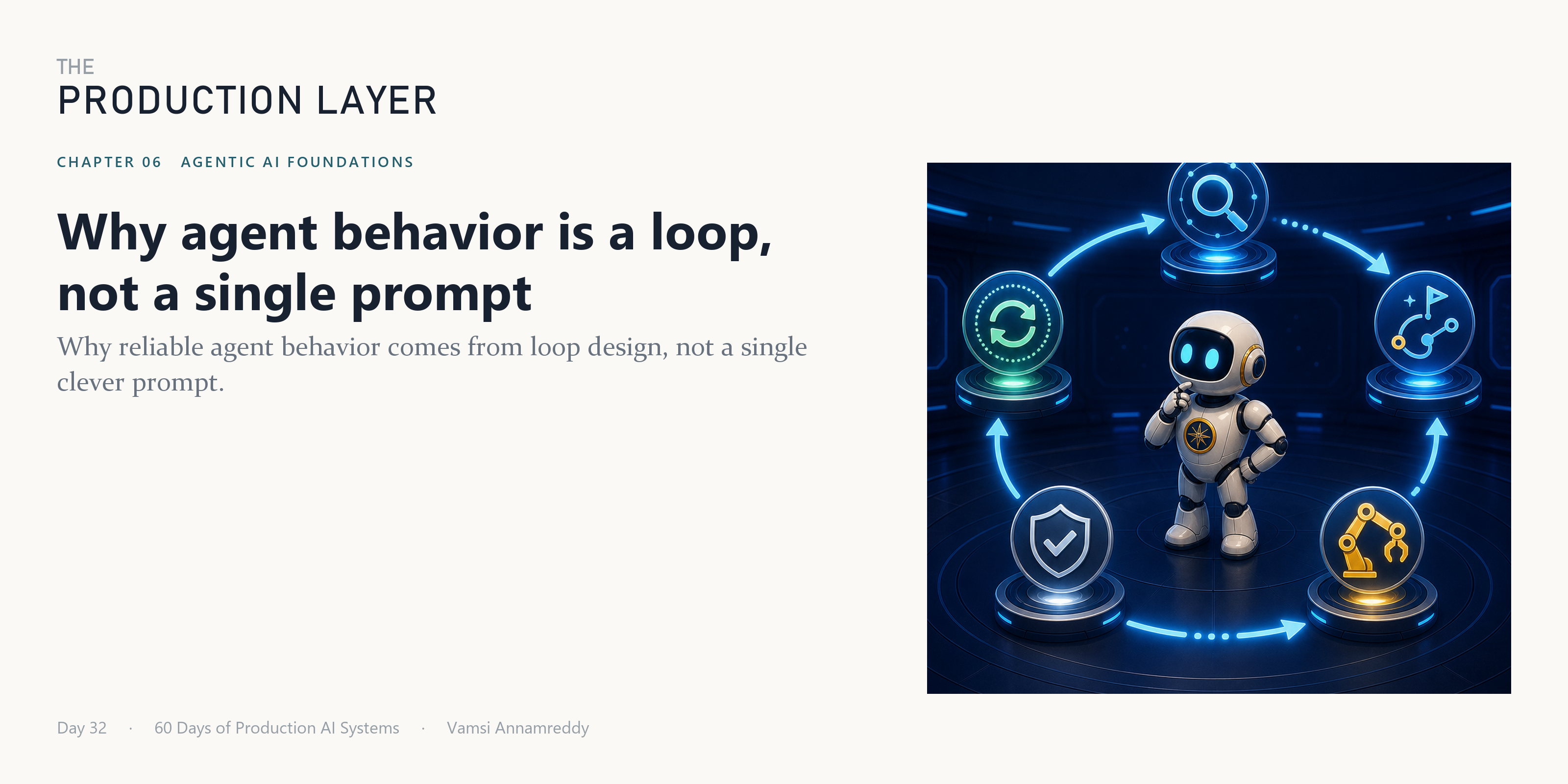
Strip away the mystique and an agent is a loop.
observe -> plan -> act -> check -> decide
             ^                   |
             |-------------------|
One LLM call is a single shot: prompt in, text out, done. An agent keeps going. It looks at the world, chooses an action, takes it, looks at what changed, and revises. The agency is not in the model. It is in the cycle.
The loop is your debugging framework
This decomposition earns its keep the first time something goes wrong, because each station is a separate thing you can inspect:
- Wrong actions from sound reasoning? Look at what the agent can observe. Agents routinely act on a state snapshot that went stale three steps ago.
- Sensible plan, broken execution? The tool layer, definitions, schemas, permissions.
- Failures nobody noticed? The check station is missing. A remarkable number of production "agents" fire an action and assume it worked, because the happy path was the only path anyone tested.
- The same mistake, repeatedly? Results are not feeding back into the plan. Without the update step you have a script with retries wearing an agent's clothes.
Notice that none of these are fixed by a better prompt. They are fixed by changing what the loop does.
Every loop needs three doors
Done, blocked, and out of budget. All three, implemented and tested.
The failure mode is not subtle once you have seen it: an agent that cannot recognise it is stuck will keep paying for the privilege of being stuck. It will re-read the same file, re-run the same failing query, re-plan its way back to the identical dead end. Each individual step will look completely reasonable in the trace.
That last point matters for debugging. Runaway loops are rarely obviously broken at any single step. They are locally sensible and globally absurd, which is why the exit conditions have to be enforced from outside the loop rather than left to the agent's judgement.
What to actually do
Run the loop on a deliberately hard input, and read the trace station by station. What evidence permitted each step? Where should it have stopped? What did it log?
You are looking for two things: a step that acted without checking, and a point where it should have exited but had no door.
Closing thought
Agents live in loops. Reliability comes from designing the loop (the observations, the checkpoints, the exits) not from asking the model to be careful.
Day 32 of 60 Days of Production AI Systems.
Which step in your agent loop needs inspection before the next action is allowed to run?
Previous: Day 31: Why agents need outcomes, boundaries, and stop conditions
Next: Day 33: Why planning reduces wasted AI actions
Day 32 of 60 · Agentic AI Foundations (chapter 6 of 10)
About the author
- I’m Vamsi, a builder focused on production AI systems. I write Production AI Field Notes to break down the architecture behind reliable LLM apps, RAG, agents, multi-agent workflows, evaluation, observability, safety, and governance. My goal is simple: help builders move beyond impressive AI demos and design systems that can be tested, operated, trusted, and improved in the real world.
Comments
Join the discussionNo comments yet. Be the first to comment.
Agentic AI Foundations
A practical foundation for agentic AI. This series explains why agents need outcomes, boundaries, stop conditions, loops, planning, tools, memory separation, and reflection that changes the next action.