
Day 33: Why planning reduces wasted AI actions
Why planning matters when actions have cost, risk, or dependencies.
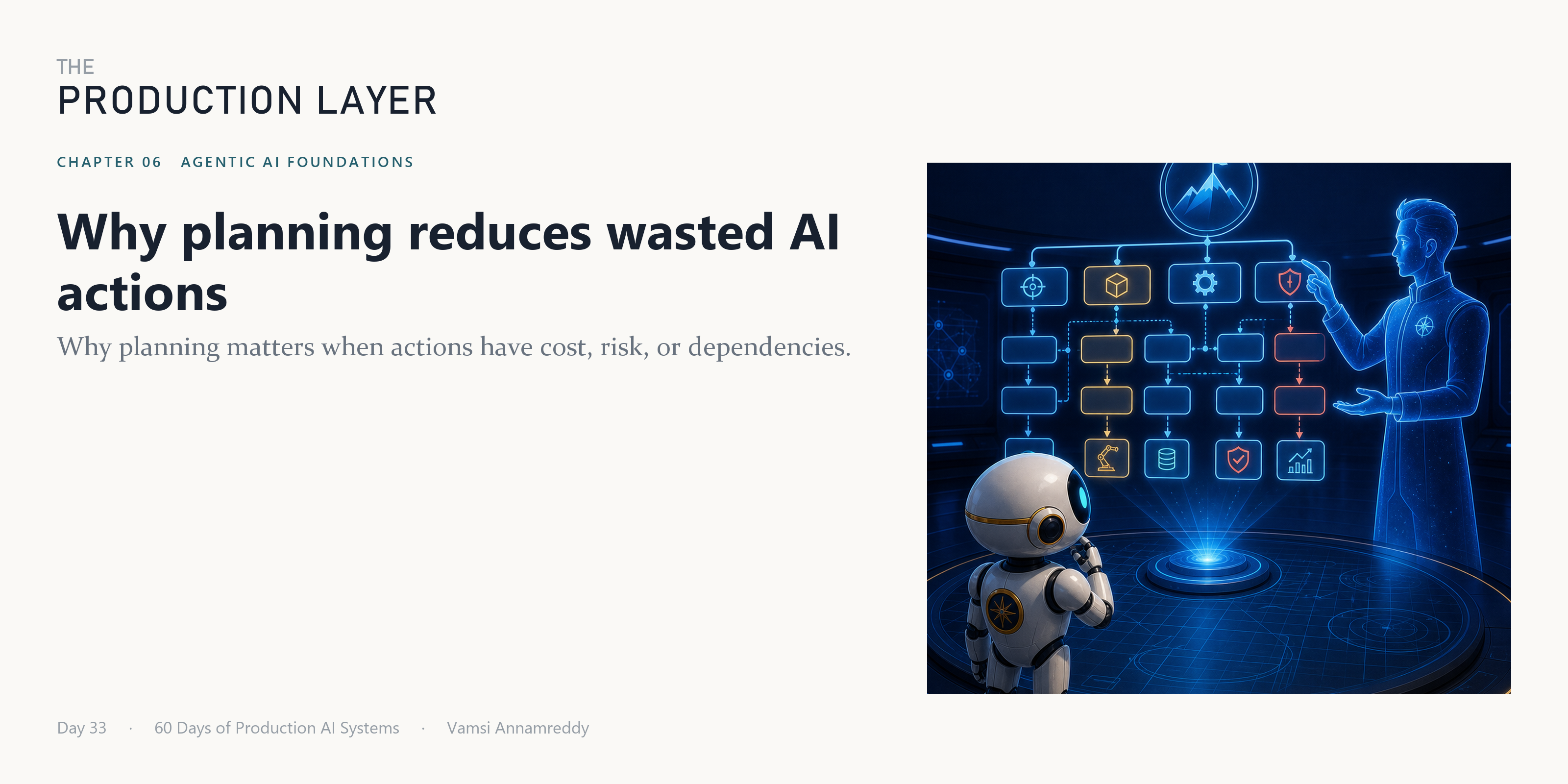
Put two traces side by side (a planning agent and a non-planning agent on the same task) and the difference is immediate.
The non-planner acts, discovers, backtracks, re-fetches data it already had, and meets the critical dependency at step nine, where unwinding costs nine steps of spend. The planner met that dependency at step zero, on paper, for the price of one model call.
Planning is cheap. Wandering is billed per token.
What makes a plan operationally useful
Not eloquence. Three properties:
- Verifiable steps. Each one can be marked done or not done without interpretation. "Research the market" fails this; "retrieve Q3 revenue for the three named competitors" passes.
- Explicit dependencies. This is what makes parallel execution safe, and it is what surfaces the blocker before you have spent anything on the branches behind it.
- Revisability. When step 3 fails, the plan updates from what actually happened. A plan the agent cannot revise is a script, and it will march confidently into a world that stopped matching its assumptions two steps ago.
The second payoff
The plan is documentation.
When you audit a run three weeks later, because a customer complained, or the bill spiked, or someone asks why the system did what it did, the plan tells you what the agent thought it was doing. That intent is half of every investigation, and without it you are reverse-engineering a sequence of tool calls into a hypothesis about motive.
A trace shows what happened. A plan shows what was supposed to happen. The gap between them is usually where the bug lives.
When to skip it
Planning has a cost, and applying it uniformly is its own failure. A single-step lookup does not need a plan; it needs an answer. If the task has one obvious action and no dependencies, a planning step is pure latency.
The trigger worth encoding: plan when actions have cost or are hard to reverse. If a tool call spends money, modifies data, or contacts a customer, spend a few hundred tokens thinking first. If the worst outcome is a slightly slow read, act.
Planning turns goals into work. It also turns an opaque sequence of tool calls into something a human can review before the expensive part starts.
Day 33 of 60 Days of Production AI Systems.
Which planning decision should be visible before your agent is allowed to touch a tool?
Previous: Day 32: Why agent behavior is a loop, not a single prompt
Next: Day 34: Why tool access is where AI becomes operational risk
Day 33 of 60 · Agentic AI Foundations (chapter 6 of 10)
About the author
- I’m Vamsi, a builder focused on production AI systems. I write Production AI Field Notes to break down the architecture behind reliable LLM apps, RAG, agents, multi-agent workflows, evaluation, observability, safety, and governance. My goal is simple: help builders move beyond impressive AI demos and design systems that can be tested, operated, trusted, and improved in the real world.
Comments
Join the discussionNo comments yet. Be the first to comment.
Agentic AI Foundations
A practical foundation for agentic AI. This series explains why agents need outcomes, boundaries, stop conditions, loops, planning, tools, memory separation, and reflection that changes the next action.