
Day 36: Why reflection should change the next action
Why reflection is valuable only when it decides whether to revise, retry, escalate, or stop.
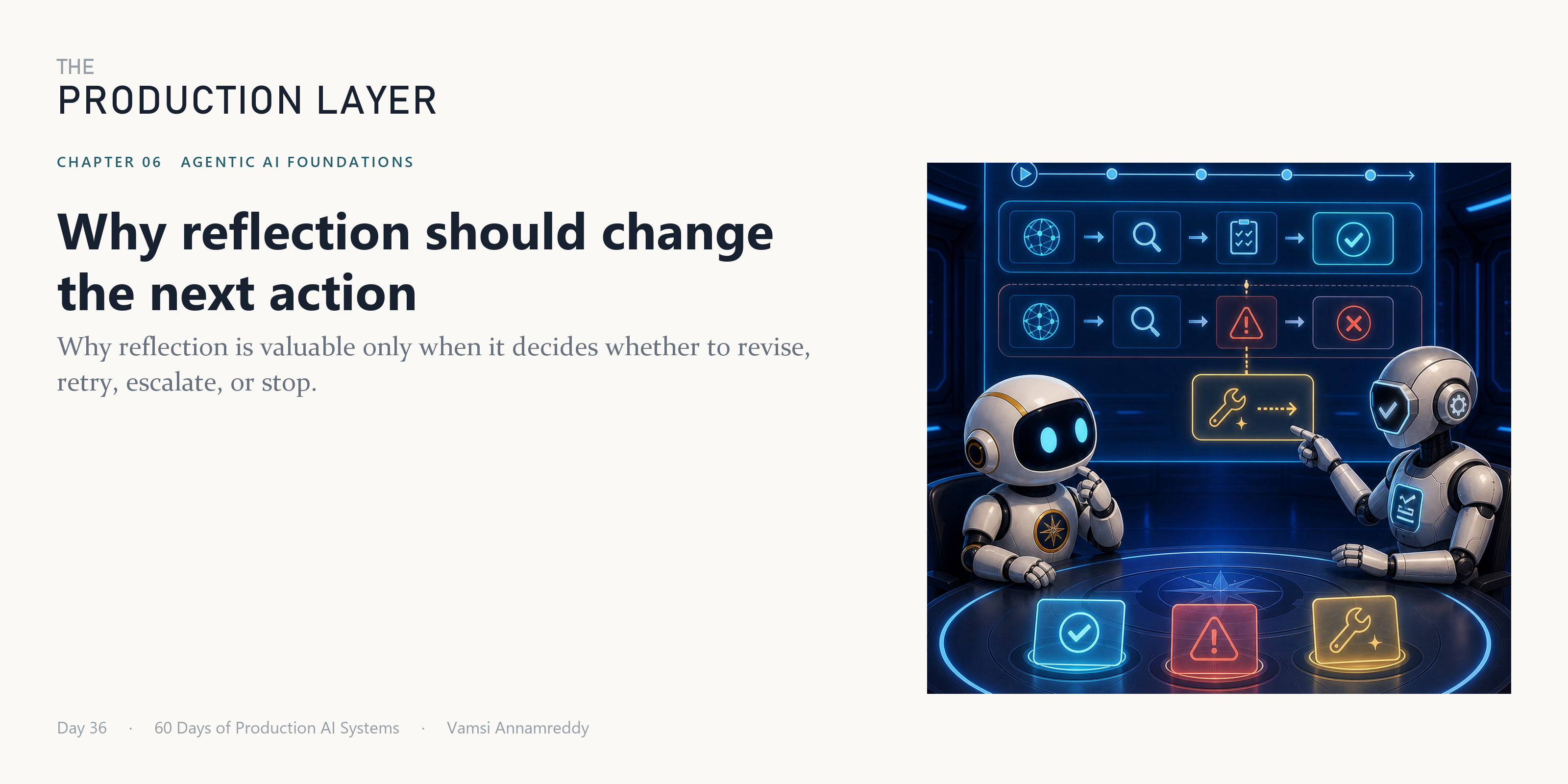
After the mission comes the debrief. Not to feel good about the flight: to change something before the next one.
There is a test for whether your agent's reflection step is real: diff the behaviour. Run the task, let it reflect, run it again. If run two is identical to run one, you paid for a paragraph.
Plausible self-critique is nearly free
LLMs are extremely good at producing sentences that sound like learning. "I should have been more thorough." "I should have verified the data before proceeding." These read as insight and change nothing, because they are not connected to anything the next run will encounter.
Real reflection has three stages, and most implementations build only the first:
- Review, compare the outcome against the goal and name the specific step that failed. Not "be more careful"; "the address was not validated before the shipping call."
- Revise: convert that finding into a concrete change: an updated procedure, a modified plan template, an added precondition.
- Persist, store the change where the next run will actually hit it. A lesson living in a transcript nobody re-reads is a lesson unlearned.
Stage three is where this connects to procedural memory from yesterday. Reflection without a persistence path is a diary. Persistence without review is thrashing.
Measure it like a system property
Reflection is not a vibe to assess by reading outputs. Track error rate on repeated task types over time.
If the line is flat, the debrief room is theatre. It is theatre you are paying for on every run, in latency and tokens. That is worth knowing, because the instinct when an agent underperforms is to add more reflection, which makes a non-functioning loop more expensive rather than more effective.
Where it earns its place
Add it where mistakes are expensive or hard to detect. Skip it on simple, verifiable, low-stakes tasks. There, extra reasoning is pure latency, and the agent will happily generate a thoughtful critique of a task that was already correct.
And cap the loop. Revise-critique-revise with no budget does not converge on quality; it converges on your rate limit.
Reflection should change the next action. If you cannot point to what changed, you have added commentary to your trace and cost to your bill.
Day 36 of 60 Days of Production AI Systems.
Do your agents learn anything between runs, or does every session start from zero?
Previous: Day 35: Why agent memory is not one database
Next: Day 37: Where human review actually belongs in AI workflows
Day 36 of 60 · Agentic AI Foundations (chapter 6 of 10)
About the author
- I’m Vamsi, a builder focused on production AI systems. I write Production AI Field Notes to break down the architecture behind reliable LLM apps, RAG, agents, multi-agent workflows, evaluation, observability, safety, and governance. My goal is simple: help builders move beyond impressive AI demos and design systems that can be tested, operated, trusted, and improved in the real world.
Comments
Join the discussionNo comments yet. Be the first to comment.
Agentic AI Foundations
A practical foundation for agentic AI. This series explains why agents need outcomes, boundaries, stop conditions, loops, planning, tools, memory separation, and reflection that changes the next action.