
Day 45: Why pipelines make AI handoffs inspectable
Why predictable AI workflows often benefit from pipeline structure before agent autonomy.
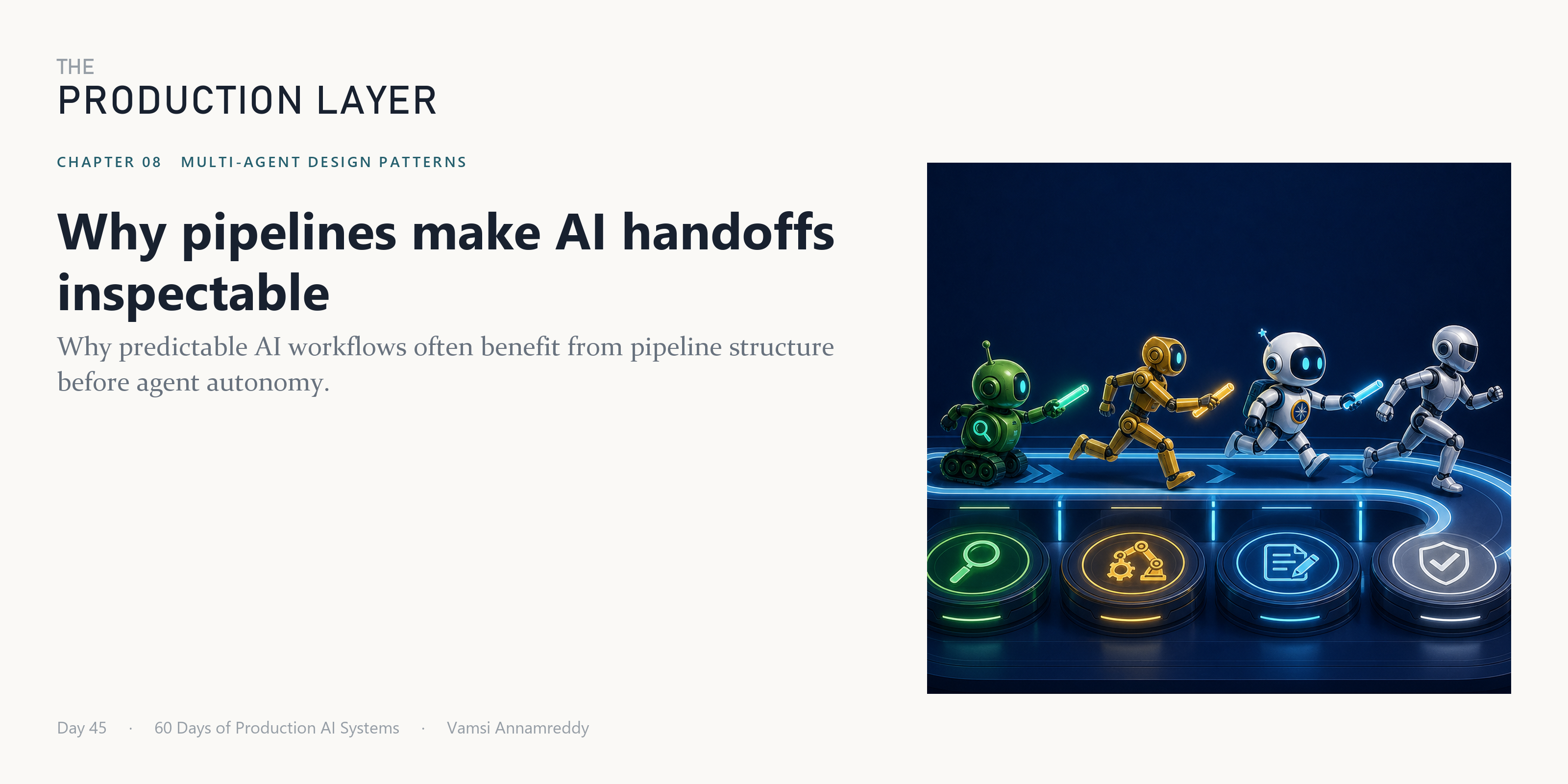
Ask an on-call engineer which multi-agent system they would rather be paged for, and they will pick the pipeline every time.
Research flows to analysis flows to writing flows to review. One direction, fixed stages, one baton. Nothing about it will impress a conference audience. Everything about it will shorten an incident.
Three operational virtues
Every boundary is a contract. Stage N receives X and produces Y. Violations surface at the boundary, immediately, instead of three stages downstream as a mystery — and "the analysis stage emitted something the writer could not use" is a far better bug report than "the output was wrong."
Debugging is bisection. Inspect the artifact at each handoff and find the leg where it degraded. Minutes, not an afternoon of re-running the whole thing with extra logging.
Stages upgrade independently. Swap the analysis model, run the same fixtures, diff the outputs. No conversation rewiring, no coordination changes, no wondering whether you broke something two hops away.
That last one compounds over time. Pipelines are the only multi-agent topology where you can confidently improve one component in isolation.
Validate between stages, and store what passed
The most common pipeline failure is the quiet one: a stage emits something subtly wrong, the next stage accepts it without checking, and four stages later the output is nonsense with no obvious origin.
Two fixes, both cheap. Validate at each boundary, schema, required fields, sanity checks on the actual content. And persist intermediate outputs, because the alternative is debugging a five-stage pipeline from its final output alone, which is roughly like debugging a program from its exit code.
The honest limit
Pipelines assume work flows forward. The moment stage 4 routinely rejects and returns work to stage 1, you no longer have a pipeline. You have a loop wearing a pipeline costume, and the costume hides the iteration count from everyone including you.
That is not a reason to avoid the pattern. It is a reason to model the loop explicitly when it appears, with a cap, rather than letting the "simple" architecture quietly become the expensive one.
A large share of production agent systems are pipelines that briefly flirted with something more autonomous and came back. That is not a failure of ambition, sequential workflows with explicit contracts are genuinely the right answer for known processes.
Day 45 of 60 Days of Production AI Systems.
Previous: Day 44: Why dynamic dispatch needs ownership rules
Next: Day 46: Why peer agents need protocols, not vibes
Day 45 of 60 · Multi-Agent Design Patterns (chapter 8 of 10)
About the author
- I’m Vamsi, a builder focused on production AI systems. I write Production AI Field Notes to break down the architecture behind reliable LLM apps, RAG, agents, multi-agent workflows, evaluation, observability, safety, and governance. My goal is simple: help builders move beyond impressive AI demos and design systems that can be tested, operated, trusted, and improved in the real world.
Comments
Join the discussionNo comments yet. Be the first to comment.
Multi-Agent Design Patterns
A practical pattern catalog for multi-agent systems. This series explains hierarchy, dynamic dispatch, pipeline handoffs, peer collaboration, shared blackboard state, and debate-with-judge patterns through production ownership and reliability questions.