
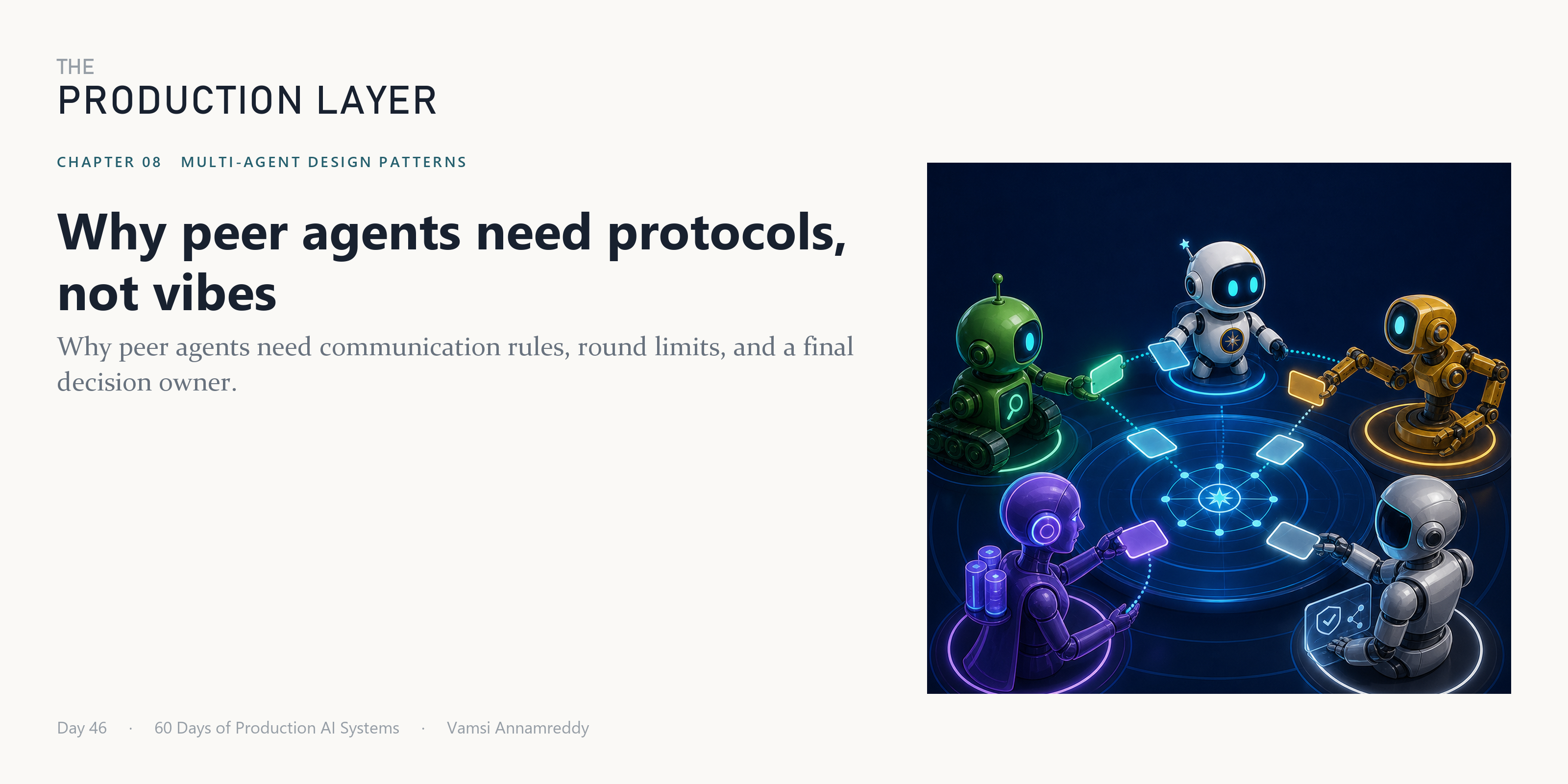
Day 46: Why peer agents need protocols, not vibes
Why peer agents need communication rules, round limits, and a final decision owner.
Take away the supervisor. Can the specialists just talk to each other?
They can. The appeal is real: no bottleneck, no single point of failure, and two experts negotiating details directly rather than routing everything through a middleman that half-understands both sides.
Then you discover you have built a distributed system, and it has inherited the entire classic failure catalogue.
The three failure modes, by name
Deadlock. Two agents each waiting on the other, politely, indefinitely. Neither is broken. Neither will move.
Livelock. The conversation cycles without converging, agents responding, refining, re-raising, generating plausible activity and no progress. This one is worse than deadlock because it looks like work, and it bills like work.
Diffusion of responsibility. Every peer assumes another peer owns the final answer, so the answer never ships. The transcript is full of useful contributions and contains no conclusion.
None of these are model-quality problems. Better prompts do not fix them, because they are properties of the coordination structure rather than of any individual agent's reasoning.
The survival kit is protocol, not personality
- Typed messages with explicit intent. Request, response, delegation, completion. Freeform chat between agents is where tasks dissolve: one agent's casual mention is another's assumed commitment.
- Single ownership at all times. Every task has exactly one current owner, and transfer is an explicit, logged event. "We are both sort of working on it" is the state you are designing against.
- Enforced termination. Round limits and timeout authority that live outside the conversation. This matters more than it sounds: deadlocked parties cannot vote themselves out of a deadlock, and a livelocked pair will not notice they are livelocked. Something external has to call time.
When it is worth it
Peers earn their complexity when they bring genuinely different expertise and the coordination between them is high-bandwidth, lots of back-and-forth that a supervisor would only garble.
If the interaction is mostly "specialist A produces something, specialist B consumes it," that is a pipeline, and a pipeline will be easier to operate in every respect.
Closing thought
Peers can coordinate without a boss. Autonomy between agents works the way it works between teams: on rules solid enough that nobody has to think about them.
Day 46 of 60 Days of Production AI Systems.
Previous: Day 45: Why pipelines make AI handoffs inspectable
Next: Day 47: Why shared state needs structure and attribution
Day 46 of 60 · Multi-Agent Design Patterns (chapter 8 of 10)
About the author
- I’m Vamsi, a builder focused on production AI systems. I write Production AI Field Notes to break down the architecture behind reliable LLM apps, RAG, agents, multi-agent workflows, evaluation, observability, safety, and governance. My goal is simple: help builders move beyond impressive AI demos and design systems that can be tested, operated, trusted, and improved in the real world.
Comments
Join the discussionNo comments yet. Be the first to comment.
Multi-Agent Design Patterns
A practical pattern catalog for multi-agent systems. This series explains hierarchy, dynamic dispatch, pipeline handoffs, peer collaboration, shared blackboard state, and debate-with-judge patterns through production ownership and reliability questions.