
Day 47: Why shared state needs structure and attribution
Why shared state needs structure, attribution, and versioning to stay debuggable.
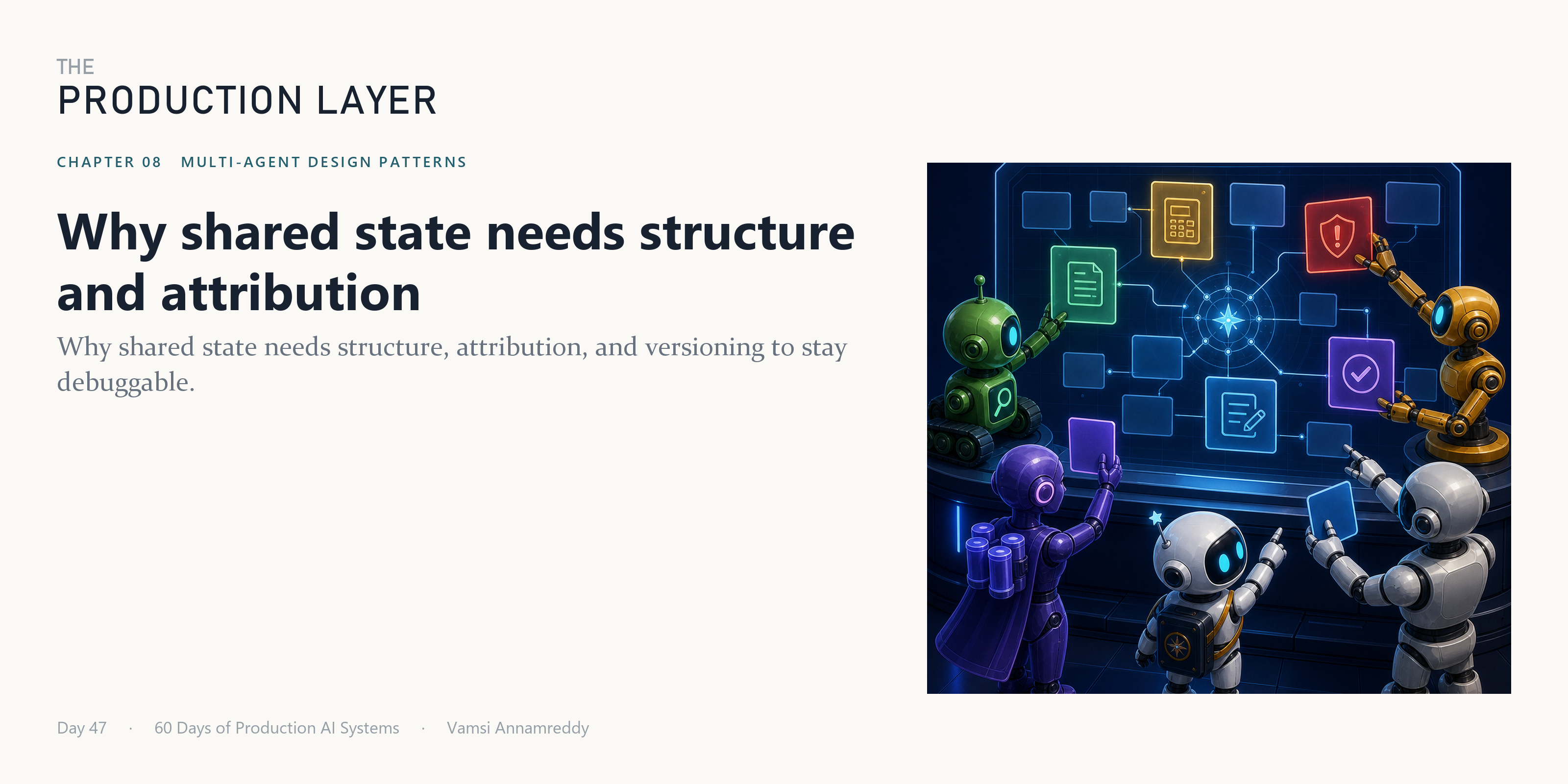
Instead of agents sending messages to each other, what if they all wrote on the same wall?
That is blackboard architecture. One shared workspace: the researcher pins evidence, the analyst posts calculations, the reviewer flags risks. Nobody sends anybody anything, the wall is the collaboration.
The elegance is genuine. Agents stay decoupled. The writer does not need to know the researcher exists, only that evidence appears in the evidence section. You can add or remove specialists without rewiring a single conversation.
Then it becomes graffiti
Shared state without rules degrades in a predictable order.
Two agents overwrite each other's findings, and the loser's work vanishes with no record it existed. An unverified hypothesis sits next to a confirmed fact with identical visual weight, and the next agent to read the wall cannot tell them apart. Nothing records who wrote what, so when the final output is wrong, the contribution that caused it is untraceable.
The uncomfortable part: lost accountability does not look like a bug. There is no error, no exception, no failed assertion. There is just a result nobody can explain, discovered weeks later.
Govern it like a database
Four rules, none of them exotic:
- Schema, not prose. Defined sections for evidence, calculations, risks, decisions. An unstructured board becomes an unsearchable wall of paragraphs within an hour of real use.
- Append-only corrections. When agent B contradicts agent A, both entries survive: timestamped and attributed. Silent overwrites destroy the audit trail at exactly the moment it becomes valuable, which is when agents disagree.
- Status with teeth. "Proposed" and "verified" are different states, and downstream agents may only build on verified. Without this, one agent's speculation becomes another's premise, laundered into fact by passing through shared state.
- Attribution on everything. "Who wrote this, from what source, when" is the first question in every post-incident review.
The test
Have two agents write to the same region simultaneously. Watch what happens.
If one silently wins, you have a data-loss bug that will show up as an inexplicable result rather than an error, and it will be intermittent, which is the worst kind.
Collaborating through shared state is powerful exactly to the degree that the state is governed. Ungoverned, it is not collaboration. It is contamination with extra steps.
Day 47 of 60 Days of Production AI Systems.
If two of your agents wrote to the same place right now, could you tell afterwards who wrote what?
Previous: Day 46: Why peer agents need protocols, not vibes
Next: Day 48: Why AI debate needs a reliable judge
Day 47 of 60 · Multi-Agent Design Patterns (chapter 8 of 10)
About the author
- I’m Vamsi, a builder focused on production AI systems. I write Production AI Field Notes to break down the architecture behind reliable LLM apps, RAG, agents, multi-agent workflows, evaluation, observability, safety, and governance. My goal is simple: help builders move beyond impressive AI demos and design systems that can be tested, operated, trusted, and improved in the real world.
Comments
Join the discussionNo comments yet. Be the first to comment.
Multi-Agent Design Patterns
A practical pattern catalog for multi-agent systems. This series explains hierarchy, dynamic dispatch, pipeline handoffs, peer collaboration, shared blackboard state, and debate-with-judge patterns through production ownership and reliability questions.