
Day 48: Why AI debate needs a reliable judge
Why AI debate is only useful when the judge has reliable criteria.
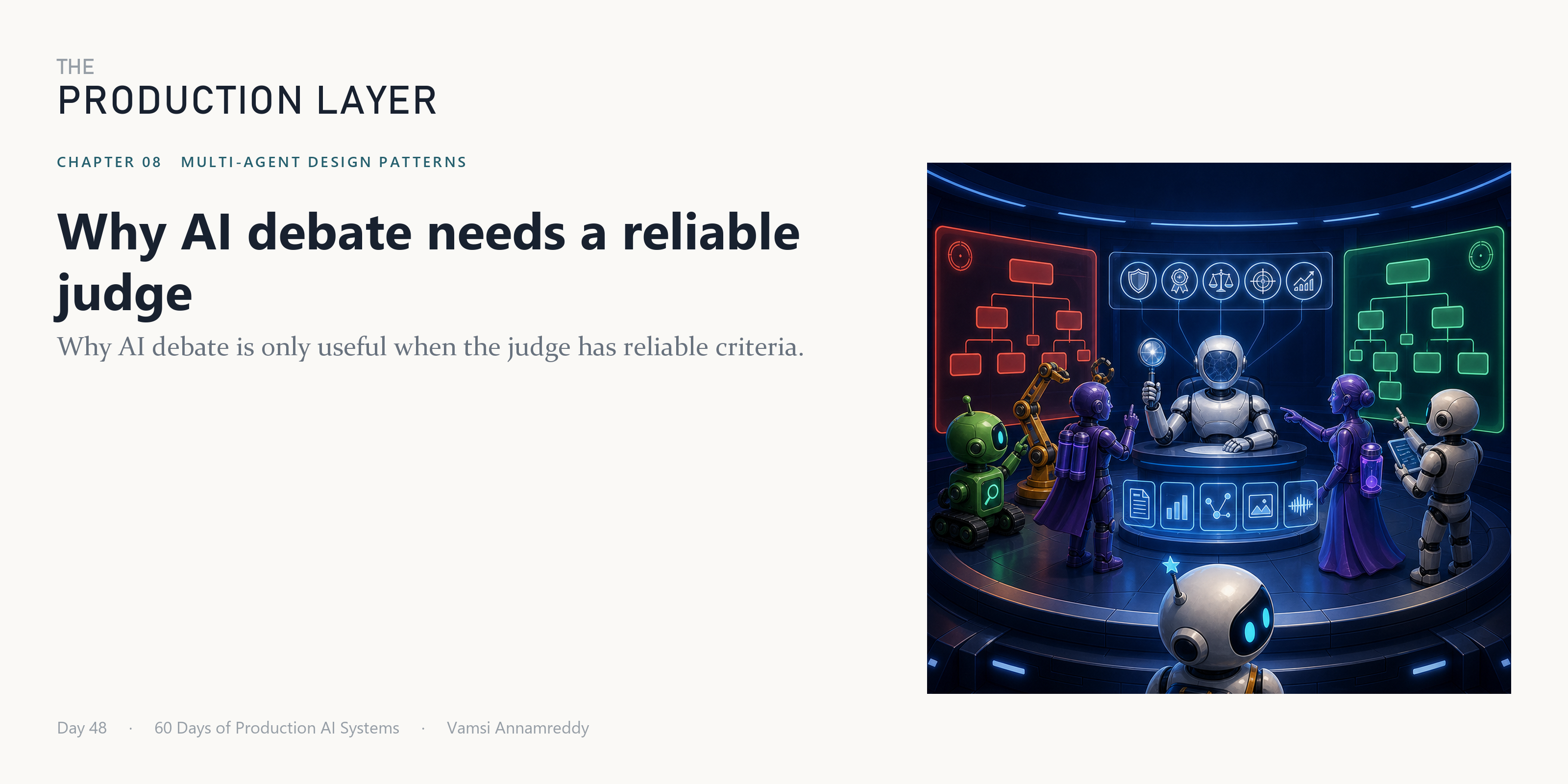
Want to find the weakness in an AI-generated plan? Assign a second AI to attack it.
Models critique other models' work far better than their own, and the debate pattern industrialises that asymmetry. Two agents argue genuinely different positions; a judge scores them against stated criteria. Under adversarial pressure, assumptions surface that neither agent would have volunteered about its own proposal.
The whole pattern rests on the judge
Not on the debaters. This is the part that gets under-designed.
A judge that rewards eloquence over evidence converts the entire apparatus into an expensive coin flip weighted toward whichever side writes more confidently. You have not eliminated error. You have given it a courtroom and a verdict, which makes it harder to question downstream.
Three checks before trusting any verdict:
- Evidence access. Does the judge see the underlying data, or only the arguments about it? Rhetoric-only judging is vibes with a gavel.
- Criteria fixed in advance. "Pick the better plan" invites charisma. "Score against these five requirements, weighted as follows" constrains it. Write them before the debate, not after seeing the arguments.
- The swap test. Rerun with the debaters' positions exchanged. If the verdict follows the agent rather than the argument, your judge is measuring style. This is the single most useful diagnostic here and it takes one extra run.
Validate the judge on known answers
Before deploying, run the judge on cases where you already know which side is right. Not obvious cases: genuinely contested ones with a determinable answer.
If it cannot reliably pick the correct side when you know the ground truth, it will not do better on live questions where you do not. That sounds obvious written down; almost nobody does it.
Reserve it for decisions that justify the cost
Debate triples inference for one answer. That is defensible for architecture decisions, go/no-go gates, and claims where being wrong is expensive.
It is not defensible for routine tasks, and routine tasks are where it tends to get switched on because the pattern is interesting.
Closing thought
Debate exposes hidden weaknesses, when the judge, the evidence, and the decision rules are sound. Otherwise it is a well-structured way to pick the more charismatic wrong answer, and to feel rigorous while doing it.
Day 48 of 60 Days of Production AI Systems.
Where would an adversarial second opinion have saved you, and who would you trust to judge it?
Previous: Day 47: Why shared state needs structure and attribution
Next: Day 49: When decentralized agent behavior makes sense
Day 48 of 60 · Multi-Agent Design Patterns (chapter 8 of 10)
About the author
- I’m Vamsi, a builder focused on production AI systems. I write Production AI Field Notes to break down the architecture behind reliable LLM apps, RAG, agents, multi-agent workflows, evaluation, observability, safety, and governance. My goal is simple: help builders move beyond impressive AI demos and design systems that can be tested, operated, trusted, and improved in the real world.
Comments
Join the discussionNo comments yet. Be the first to comment.
Multi-Agent Design Patterns
A practical pattern catalog for multi-agent systems. This series explains hierarchy, dynamic dispatch, pipeline handoffs, peer collaboration, shared blackboard state, and debate-with-judge patterns through production ownership and reliability questions.