
Day 49: When decentralized agent behavior makes sense
Why decentralized agent behavior needs convergence rules before it earns production trust.
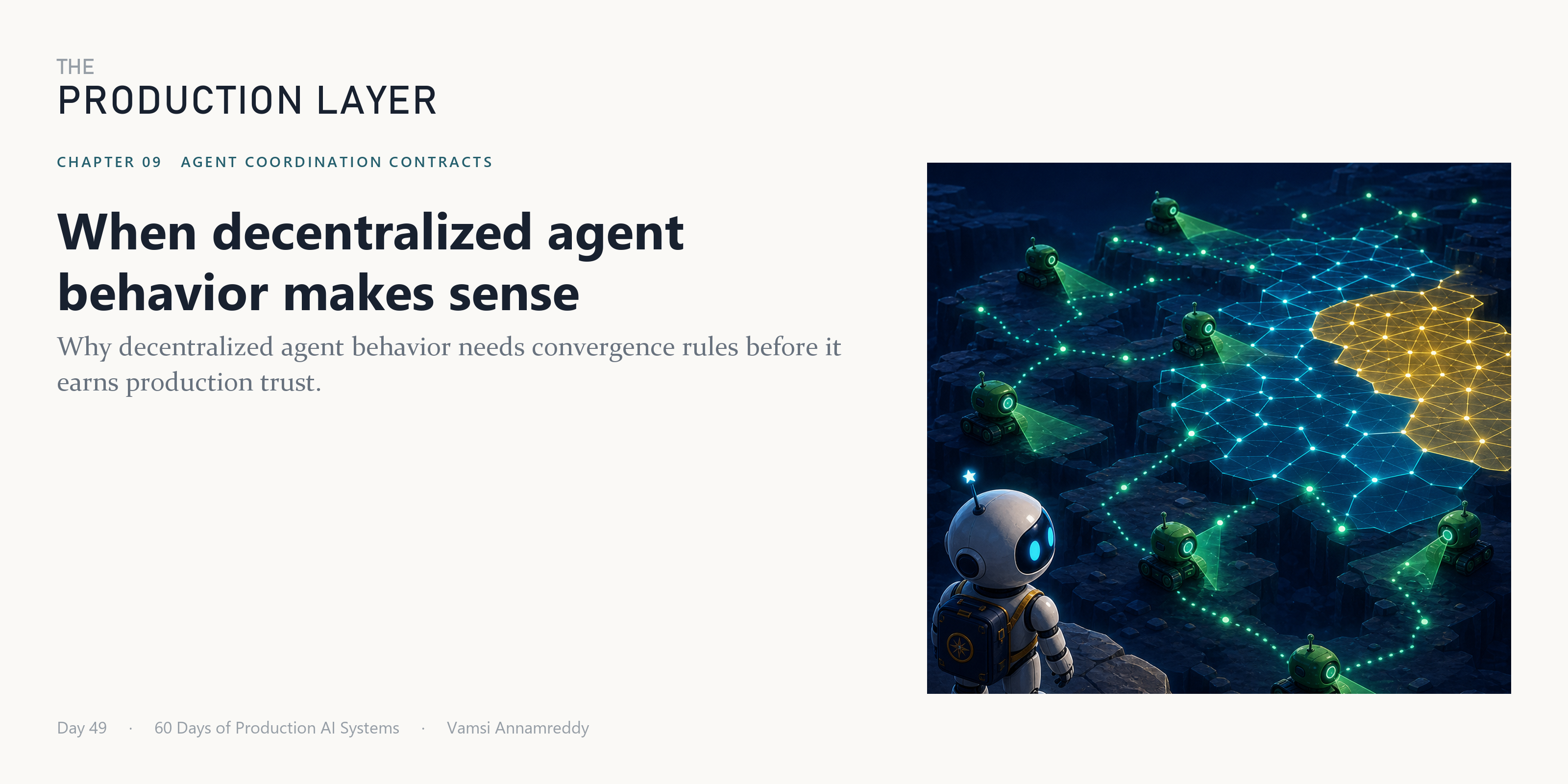
No leader, no plan, no meetings, and the map still gets made.
A swarm deletes the coordinator entirely. Many small agents follow local rules: go where coverage is thin, mark what you find, do not crowd your neighbours. No agent holds the global picture. Coverage emerges rather than being assigned.
The trade, stated without romance
You gain resilience. Lose five workers and nothing breaks. There is no orchestrator to crash, no bottleneck to saturate, no single point of failure because there is no single point of anything.
You lose explainability. When the collective output is wrong, no individual agent "decided" anything. There is no decision to inspect, no reasoning chain to follow. Debugging becomes statistics. You are analysing distributions of behaviour rather than tracing a path.
For a lot of production work that second cost is disqualifying on its own, and it is worth being honest about that before the architecture diagram gets drawn.
Where the trade actually pays
Embarrassingly parallel exploration with cheap verification.
Sweeping a large codebase for a vulnerability class. Validating thousands of records. Searching a wide space where any worker can independently confirm a hit. The common thread: work that divides cleanly, and results that can be checked without reassembling the whole picture.
That verification requirement is doing heavy lifting. A swarm's raw output is noisy by design (that is the mechanism, not a defect) so something downstream must separate signal from it. Build the verifier before the swarm. Without one you have bought parallelism and inherited a filtering problem you cannot solve.
Where it does not
Anything needing sequencing, judgement, or an accountable decision. A swarm cannot own an outcome. Something above it has to, and if that something does not exist, "who decided this?" has no answer at all.
Define convergence before you start: what aggregation rule turns many partial results into one answer, and what stops the exploration. Without both, you have motion, rising cost, and no owner.
Closing thought
Simple local rules can produce collective intelligence. They can also produce a very expensive random walk, and from inside the system the two look similar for a surprisingly long time.
As inference gets cheaper, the frontier shifts from "can we afford many agents" to "can we verify what many agents produce." The second question is the harder one.
Day 49 of 60 Days of Production AI Systems.
Previous: Day 48: Why AI debate needs a reliable judge
Next: Day 50: Why role design matters more than agent count
Day 49 of 60 · Agent Coordination Contracts (chapter 9 of 10)
About the author
- I’m Vamsi, a builder focused on production AI systems. I write Production AI Field Notes to break down the architecture behind reliable LLM apps, RAG, agents, multi-agent workflows, evaluation, observability, safety, and governance. My goal is simple: help builders move beyond impressive AI demos and design systems that can be tested, operated, trusted, and improved in the real world.
Comments
Join the discussionNo comments yet. Be the first to comment.
Agent Coordination Contracts
A practical series on the contracts that let agents coordinate without chaos. It covers decentralized behavior, role design, shared communication, shared versus private memory, handoff payloads, and decision rules when agents disagree.