
Day 60: From model demos to mission-ready AI systems
A practical map for moving from impressive AI demos to systems people can trust.
Sixty days ago this series started with one claim: AI is a system, not a model.
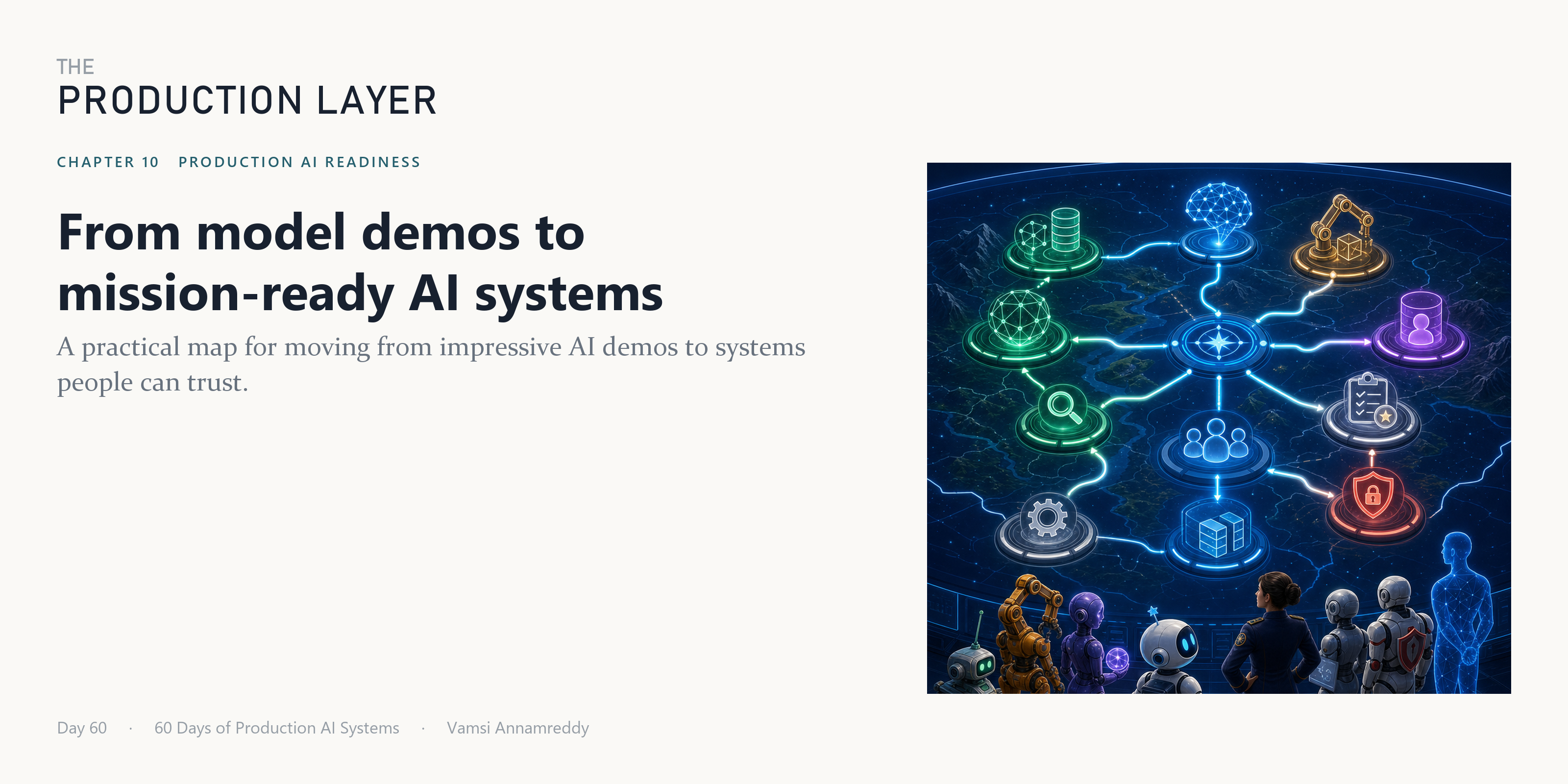
Here is the map that claim produces, and the question each layer has to answer before it is production-ready.
| Layer | The production question |
|---|---|
| Model | What behaviour is the model actually responsible for? |
| Context | What evidence and instructions enter the task? |
| Retrieval | Can it find trusted, current, authorised evidence? |
| Tools | What actions are allowed, logged, and reversible? |
| Agents | Where is autonomy useful, and where is it bounded? |
| Evaluation | How do we know the system is improving? |
| Governance | Who owns risk, review, and accountability? |
Five principles, in order
Start simple. A chatbot that works beats an agent that impresses. Complexity is a cost paid on every request, forever; add it when a failure demands it, not when a demo suggests it. (Days 1–10)
Ground every answer. Retrieval, evidence gates, citations. A system that can show its sources can be debugged, audited, and trusted. One that cannot is a rumour generator with good uptime. (11–30)
Control every action. Goals with checkable success criteria, tools with scoped permissions, budgets with enforced ceilings, recovery designed before the failure. (31–40)
Coordinate carefully. Multiple agents only when permissions, parallelism, or context isolation genuinely demand them, with contracts at every boundary. (41–50)
Measure and own everything. Tracing, system-level evaluation, injection defence, and a named human accountable for each system in production. (51–59)
The one habit worth keeping
If only a single thing survives contact with your roadmap, take this one: make the system inspectable.
Every hard problem in these sixty notes, hallucination, stale evidence, prompt injection, runaway cost, coordination failure, unexplainable decisions — shrinks the moment you can see what actually happened. Observability is not a layer alongside the others. It is the property that makes all the others fixable.
The mistake I would most want you to avoid
Treating the ecosystem as a shopping list. Adding RAG, tools, memory, agents, and evaluation as separate initiatives does not produce a production system. It produces five components nobody coordinates and one outcome nobody owns.
Start from the user outcome and work backwards. Choose the smallest architecture that can be operated safely. Earn each addition.
Closing thought
From model to mission-ready AI: not more pieces, but coordinated pieces that can be trusted in production.
Thank you for reading all sixty. The notes end here; the operating never does.
Day 60 of 60 Days of Production AI Systems.
If you had to operate your whole AI stack for a year, what would you redesign first?
Previous: Day 59: Why production AI is coordinated infrastructure
Day 60 of 60 · Production AI Readiness (chapter 10 of 10)
About the author
- I’m Vamsi, a builder focused on production AI systems. I write Production AI Field Notes to break down the architecture behind reliable LLM apps, RAG, agents, multi-agent workflows, evaluation, observability, safety, and governance. My goal is simple: help builders move beyond impressive AI demos and design systems that can be tested, operated, trusted, and improved in the real world.
Comments
Join the discussionNo comments yet. Be the first to comment.
Production AI Readiness
A closing series for moving from AI demos to systems people can trust. It covers observability, workflow evaluation, prompt injection and data leakage risk, governance, end-to-end production architecture, and the complete AI ecosystem map.